Due Feb 7
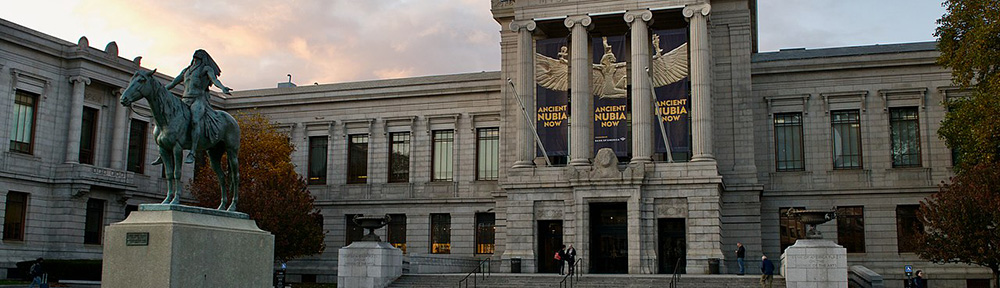
Boston’s Museum of Fine Arts
The Museum of Fine Arts was founded in 1870, during an era when wealthy elites sought to address social ills through philanthropy. Industrialization was generating both terrible poverty and great wealth, and while some sought to address core issues like sanitation and malnutrition, many of the era’s robber barons focused on making high culture available to the masses: libraries, museums, opera houses. It’s easy to make fun of this impulse: as historian Meaghan O’Connor comments sardonically, institutions like New York’s Metropolitan Museum of Art “were meant to improve society, not by solving problems of economic disparity, but by encouraging a refining of culture.” Yet were it not for this impulse, far more of our cultural legacy would have remained in private collections, closed to the general public.
The MFA’s collection reflects the taste of its founders, supporters and curators down through the decades. It’s particularly strong in Greek, Roman and Egyptian antiquities—as well as Chinese and Japanese artwork collected by Boston’s great merchant families involved in the Asia trade.
Self-guided excursion. Explore the MFA Boston on your own or with a friend, on a date of your choosing. The date shown above is just a suggestion—but if you can make it in by Feb 17, the soon-to-close exhibit “Power of the People: Art and Democracy” addresses themes I care a lot about.
Your Mission: Insofar as this excursion feeds into Essay 1, be sure to check out the Ancient Near East, Ancient Egypt, and Ancient Greece exhibits, rooms 108-113 and 212-215 on the first and second floor (museum map). Ideally, take a moment during your visit to read over the assignment prompt for Essay 1, and then look around for an artifacts you might write about. Then take LOTS of photographs, so you’re well-stocked with materials to use in writing that essay.
In addition: to document your attendance—and to start a conversation about museums—use the comments space below to post a photo of yourself at the museum posed next to an interesting artifact, along with a comment about what you find interesting about it.