Due Apr 10
Self-Reflection and the Orient
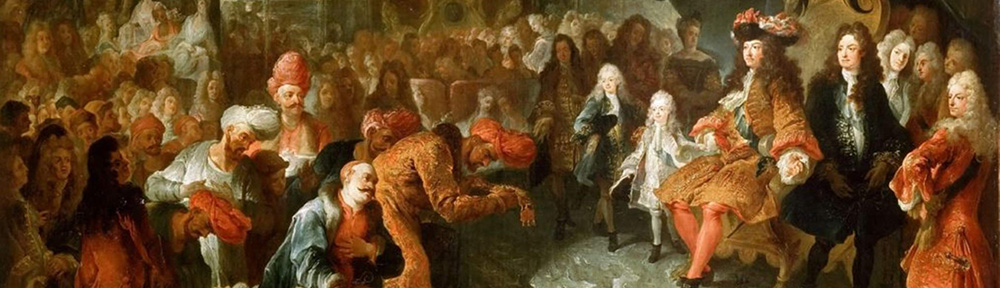
In 1714, the Safavid Shah of Persia sent the Mayor of Erivan, Mohammed Reza Beg, on an ambassadorial mission to the court of Louis XIV of France. The two countries had a common enemy in Ottoman Turkey, and while the visit did not result in a formal alliance, it did cause quite a stir in Paris. As documented in this series of blog entries, Beg’s visit was reported in the press as well as being commemorated by court painter. Of particular interest was Beg’s insistence on daily bathing, necessitating expensive renovations to the Hôtel where he stayed—a practice that the French elite soon imitated.
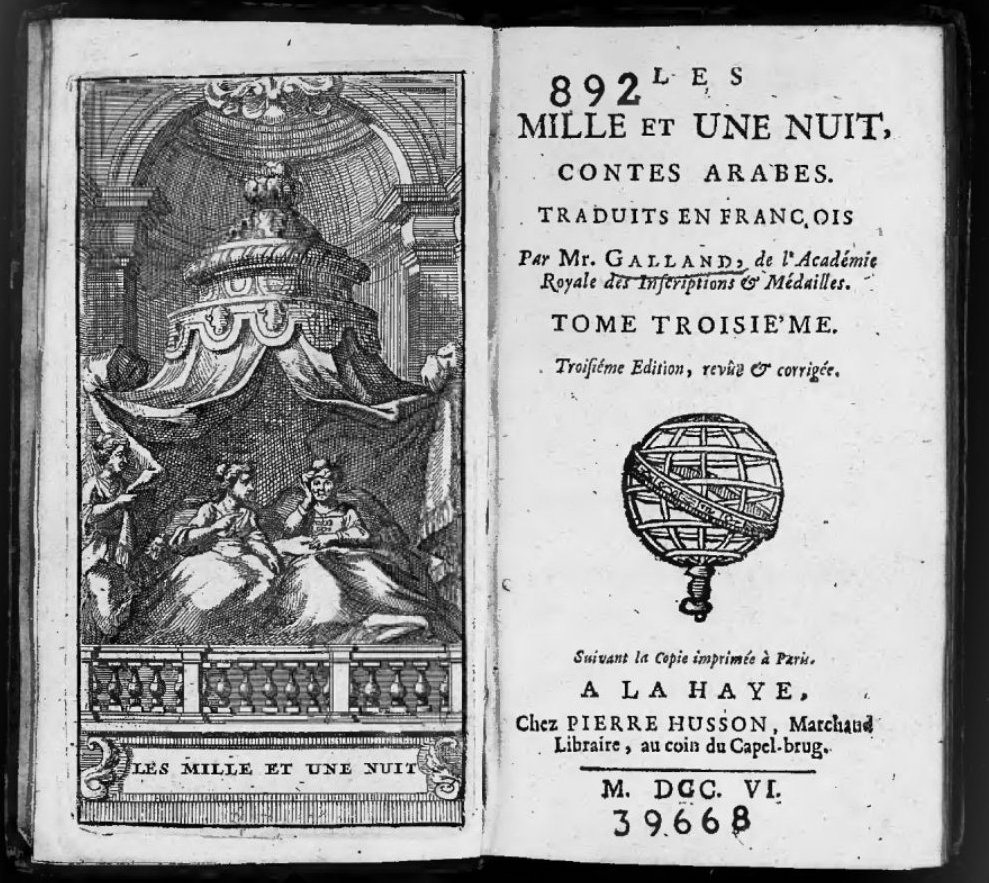 Just ten years earlier, Antoine Galland generated interest in the “Orient” (what we today call the Middle East) with the publication of the first volume of his 12-volume translation of The Thousand and One Nights, introducing Scheherazade, Aladdin, and Sinbad to an European audience.
This is the context in which we’re going to approach The Persian Letters, written by the political philosopher Charles Montesquieu. Published in 1721, six years after the real-life visit of the Persian ambassador, the volume purports to be a translation of documents left behind by a pair of Persian nobles after their extended stay in Paris. The letters detail the commentary of these fictional visitors regarding French customs, but also goings-on back in Persia. In the words of historian Susan Mokhberi, “With the publication of Montesquieu’s Persian Letters in 1721, Persians moved from objects of curiosity—as witnessed in the reception of Mohammad Reza Beg in 1715—to objects of critical reflection”: a mirror in which the French might examine their own social mores and prejudices.
Lady Mary Wortley Montagu presents a second instance of the same trend. The freethinking daughter of the 5th Earl of Kingston, Montagu eloped with a progressive member of Parliament to escape an arranged marriage. After her husband Edward was named ambassador to the Ottoman emperor of Turkey, she spent several years living abroad, during which time she recorded her experiences and observations in correspondence with friends which was later published as The Turkish Letters. Where Montaigne offers a critique of French mores from an imagined foreign perspective, Montagu’s critique is based in real-world observation.
Reading: Montesquieu, The Persian Letters, Preface as well as Letters # 1-4, 45, 55 & 56 (Montesquieu.pdf).
Reading: Montagu, The Turkish Embassy Letters, Letter 26 (Montagu.pdf).
Writing: Respond to ONE of the following prompts. Keep your response short, posting as a reply under the appropriate heading in the comments section:
- Several of Montesquieu’s letters focus on melodrama in Uzbek’s seraglio. Keying on a particular event or detail, comment on this exotic locale. Does Montesquieu strike you as interested, fundamentally, in gender relations or in power?
- Other letters focus on European life and customs from the perspective of these Persian visitors. Keying on a particular event or detail, comment as to one target of Montesquieu’s critique.
- How does Montagu’s cultural critique differ from Montesquieu’s? Rather than listing a bunch of differences, focus on one. Or, better, name an obvious difference, then go into depth with a vital difference.
Melodrama in the Seraglio
⤹Click the reply button just below.
Critique of European Customs
⤹Click the reply button just below.
Montagu vs. Montesquieu
⤹Click the reply button just below.