Due Apr 8
Self-Reflection and the Orient
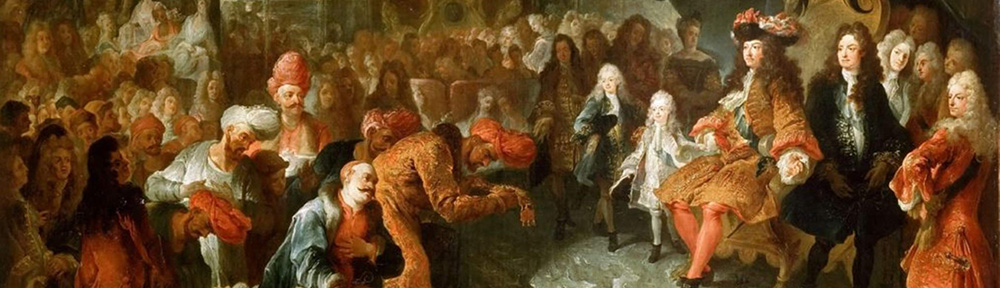
In 1714, the Safavid Shah of Persia sent the Mayor of Erivan, Mohammed Reza Beg, on an ambassadorial mission to the court of Louis XIV of France. The two countries had a common enemy in Ottoman Turkey, and while the visit did not result in a formal alliance, it did cause quite a stir in Paris. As documented in this series of blog entries, Beg’s visit was reported in the press as well as being commemorated by court painter. Of particular interest was Beg’s insistence on daily bathing, necessitating expensive renovations to the Hôtel where he stayed—a practice that the French elite soon imitated.
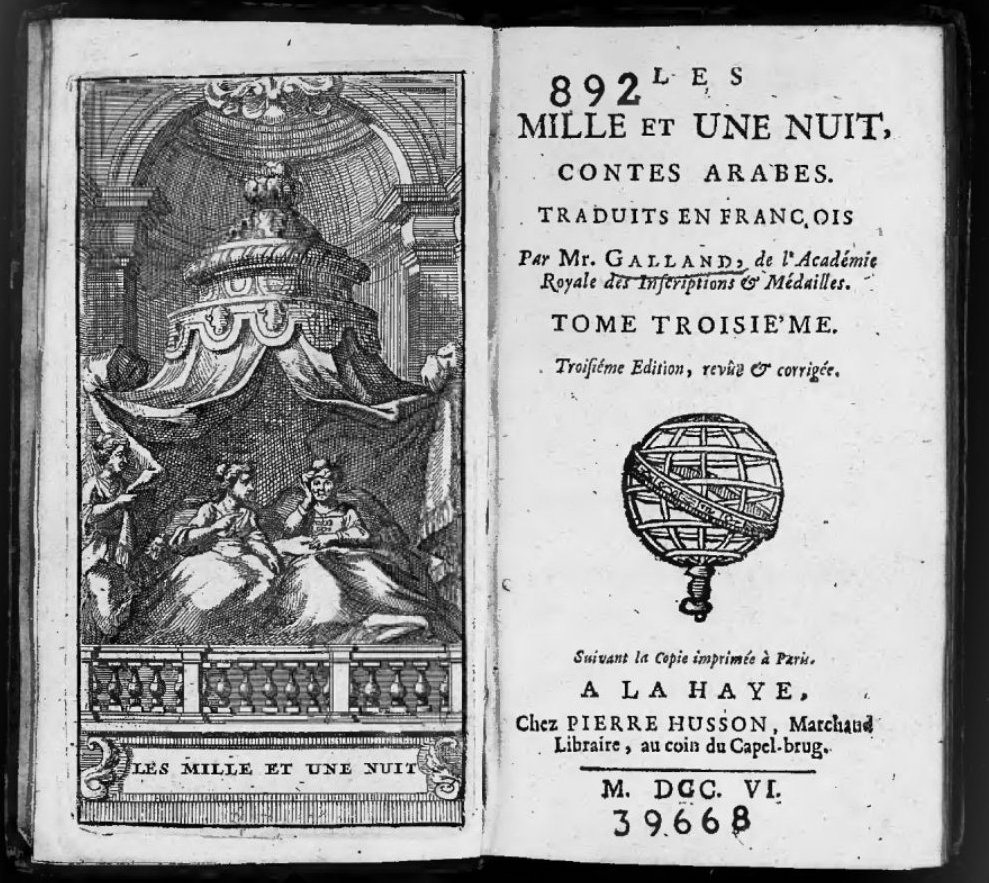 Just ten years earlier, Antoine Galland generated interest in the “Orient” (what we today call the Middle East) with the publication of the first volume of his 12-volume translation of The Thousand and One Nights, introducing Scheherazade, Aladdin, and Sinbad to an European audience.
This is the context in which we’re going to approach The Persian Letters, written by the political philosopher Charles Montesquieu. Published in 1721, six years after the real-life visit of the Persian ambassador, the volume purports to be a translation of documents left behind by a pair of Persian nobles after their extended stay in Paris. The letters detail the commentary of these fictional visitors regarding French customs, but also goings-on back in Persia. In the words of historian Susan Mokhberi, “With the publication of Montesquieu’s Persian Letters in 1721, Persians moved from objects of curiosity—as witnessed in the reception of Mohammad Reza Beg in 1715—to objects of critical reflection”: a mirror in which the French might examine their own social mores and prejudices.
Lady Mary Wortley Montagu presents a second instance of the same trend. The freethinking daughter of the 5th Earl of Kingston, Montagu eloped with a progressive member of Parliament to escape an arranged marriage. After her husband Edward was named ambassador to the Ottoman emperor of Turkey, she spent several years living abroad, during which time she recorded her experiences and observations in correspondence with friends which was later published as The Turkish Letters. Where Montaigne offers a critique of French mores from an imagined foreign perspective, Montagu’s critique is based in real-world observation.
Reading: Montesquieu, The Persian Letters, Preface as well as Letters # 1-4, 45, 55 & 56 (Montesquieu.pdf).
Reading: Montagu, The Turkish Embassy Letters, Letter 26 (Montagu.pdf).
Writing: Respond to ONE of the following prompts. Keep your response short, posting as a reply under the appropriate heading in the comments section:
- Several of Montesquieu’s letters focus on melodrama in Uzbek’s seraglio. Keying on a particular event or detail, comment on this exotic locale. Does Montesquieu strike you as interested, fundamentally, in gender relations or in power?
- Other letters focus on European life and customs from the perspective of these Persian visitors. Keying on a particular event or detail, comment as to one target of Montesquieu’s critique.
- How does Montagu’s cultural critique differ from Montesquieu’s? Rather than listing a bunch of differences, focus on one. Or, better, name an obvious difference, then go into depth with a vital difference.
Melodrama in the Seraglio
⤹Click the reply button just below.
The letters written from Uzbek’s wives in the seraglio share common themes of sadness and a desire to reunite with their husband. In Zachi’s letter to Uzbek, for example, she writes, “…the seraglio is filled with the breath of love, yet your indifference takes you ever farther from it…” (Letter 3). While intended to be a secluded place where women can be safely kept under the guard of eunuchs, these harems seem to be the source of domestic disputes between the women kept in them and their husbands who are keeping them there. This leads me to believe Montesquieu is in fact interested in gender relations, specifically the relationships between the wives and their shared husband, and how the polygamous structure of their relationships with the added factor of being secluded from the world and separated from their husband acts as a source of contention. I also assume Montesquieu’s fascination with this topic stems from polygamy being a foreign or “exotic” custom to him as a Frenchman.
I absolutely agree with Sophia here that Montesquieu was much more focused on gender relationships as compared to focusing on power. Much like Sophia mentions, Montesquieu’s language throughout, especially in Letter 3, presents in a very sensual, yearning manner, where Zachi expresses her heartfelt love and commitment to Usbek; singing his praises, and longing for the time and connection they once had. This, is epitomized in in the text when Zachi says, “I confess to you, Usbek, that a passion more powerful than ambition made me long to please you. I saw myself gradually become mistress of your heart; you chose me; you left me; you returned to me, and this time I kept you” (Montesquieu 3). This line here displays Zachi’s absolute loyalty to Usbek, as even through his infidelity and absence from her life, she shan’t forget him or desecrate his her love for him. These themes being present throughout presents Montesquieu as someone who was interested in exploring gender relations, putting a lesser focus on the interests of power dynamics and influence.
Targets of Montesquieu’s Critique
⤹Click the reply button just below.
Letter 55 pertains to Montesquieu utilizing Usbek’s observations of the French clergy to critique the religious hypocrisy present. He pinpoints the three vows the monks take: poverty, obedience, and chastity. Montesquieu targets the church’s wealth saying poverty wasn’t upkept in the slightest, while simultaneously critiquing the lack of spiritual integrity by the Church’s leaders. He points out the religious economic exploitation that’s hidden behind the scenes
I agree with your point. In letter 55 its states, “they never renounce their title of ‘poor’; our glorious sultan would sooner renounce his sublime and magnificent honorifics, and they are quite right, for the title of ‘poor’ prevents them from being so.” This quote highlights the contradiction between the monks’ stated vows and their actual behavior of accumulating wealth and power, while also implying that the Church’s moral authority hides material and institutional self interest.
In Persian Letters, Montesquieu critiques European religious hypocrisy by showing how people argue about faith but fail to love morally. For example, Usbek observes that “they seem to be competing over who can observe it the least” (Montesquieu 56), pointing out that religion becomes more about debate than actual virtue. This targets the shallow practice of religion in Europe, where outward display and arguments replace genuine ethical behavior.
I think what you’re talking about can also be extended to Letter 56 where Rica mentions that, “An infinite number of Masters of Languages, Arts, and Science teach what they themselves do not know; this is quite a notable talent, for to teach what one knows requires but little wit, whereas an infinite quantity is needed to teach what one does not know” (Montesquieu 76-77). Here, Montesquieu is criticizing the similar performative behavior as it is being applied to more than just religion. He’s saying that Parisians defy the very foundation of being an intellectual by trying to appear as such without actually being well-versed in any of the subsequent fields. By pointing this out, Montesquieu is criticizing the hypocritical pursuit of vanity that is apparent in Paris.
Contrasting Montesquieu with Montagu
⤹Click the reply button just below.
The main difference between Montesquieu and Montagus letters is that Monestquieus letters focused mainly on superficial things, whereas Montagu had deep insightful thoughts on things like religion and peoples belief. The main difference I noticed was in letter 44, where Usbek questions peoples religion and if they are truly pleasing their gods or rather themselves, and I compared this to Montesquieus letter XVII, where she finds herself discussing womens skin, hair, and their style of dress.
I think the biggest difference is that Montagu goes to the Orient in real life, but Montesquieu only imagines it. Montesquieu used the Persian travelers as a mirror. He wants to show French people that their own customs are strange or silly. But Lady Montagu is different because she is an eyewitness. She says Turkish women have more freedom than English women because their veils let them go out and stay incognito. Montesquieu used the East to discuss French power, but Montagu used her own travels to show that English ideas about women are wrong.
An obvious difference is that Charles Montesquieu uses a fictional character in The Persian Letters while Montagu writes with real first-hand experience in The Turkey Embassy Letters. Overall, Montesquieu uses foreign perspective to critique France, while Montagu uses her real observations and first-hand witness to critique European stereotypes.