G2 Class 5.1

Due Feb 13

Classical Poets on Love

Today we read a series of ancient poets on the topic of love and desire. Trigger Warning: both Hesiod and Ovid tell stories of sexual coercion.

Reading: Hesiod’s lyric poetry (~700 BCE) served, alongside Homeric epic, as the foundation of Ancient Greek culture. His account of creation foregrounds Eros (desire) as one of the fundamental drives in nature. (Hesiod-Theogony.pdf)

Reading: Sappho (~600 BCE) was celebrated in antiquity as the “tenth muse” because of the beauty of her lyric poetry. While few of her poems survive in full, we have an abundance of fragments, due to the frequency with which later writers quoted her. What’s puzzling is the cultural context in which her lyrics were performed, given the social strictures on women in Ancient Greece. Most scholars today believe she held an officially sanctioned position of some kind, whether as priestess of Aphrodite, supervisor of girls’ ritual education, or leader of a chorus of women dedicated to the Muses. (Sappho.pdf)

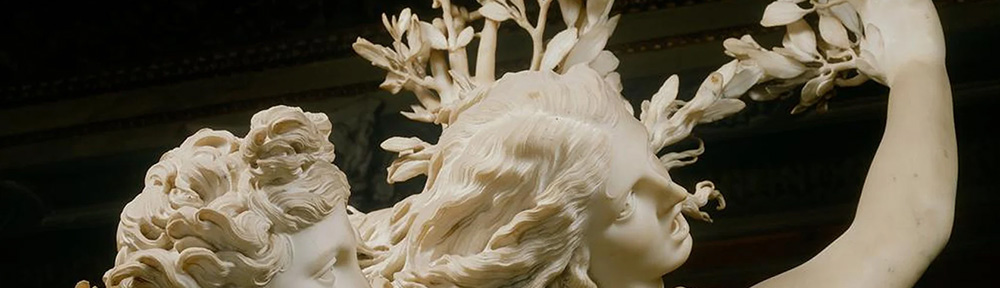
Reading: Ovid was one of the great Roman poets, whereas Hesiod and Sappho were both Greek. Born 43 BCE, he was banished to the Roman Empire’s far East because his voluptuous verse ran afoul of the aging emperor’s moralism. His Metamorphoses, published from exile in 8 CE, reworks Greek myth to present the world’s history as a seemingly endless, desire-driven sequence of changes. We are reading the story of one such metamorphosis, Apollo and Daphne. (Ovid Apollo Daphne.pdf)

Writing: Respond to ONE of the following prompts. Keep your response short, posting as a reply under the appropriate heading in the comments section:

  1. Hesiod’s creation invites comparison to the Enuma Elish. Point to something that the two stories have in common—or something that makes them distinct.
  2. Sappho is famous for presenting the first-person experience of desire. Quote a telling line or phrase and comment on the emotional experience it conveys.
  3. Aestheticizing violence: point to and discuss a moment in Hesiod or Ovid where beauty is mixed with or in proximity to violence. If you can, give a 1-sentence paraphrase of what the artist/author seems to be saying about the relationship between violence and beauty—or possibly art.

Further Reading: For those interested in the scholarly puzzle of Sappho, here are two scholarly pieces:

  • The introductory essay on Sappho in the Norton Anthology of World Literature: (link)
  • Claude Calame scholarly paper debating Sappho’s social group or institution: (link)

11 responses to “G2 Class 5.1

    • A similarity between the Enuma Eilish and Hesoid’s creation is the fact that the components of earth are made up of the godly figures. In the Enuma Eilish, Tiamat’s body is used to create the sky and the earth and, in Hesoid, the gods appear and together make up the different aspects of our world. A key difference between the stories is Tiamat’s body makes up the entire world where, in Hesoid, many different gods play individual roles as different components.

      • While I agree with you conceptually, I would argue that the components of the earth are technically made from multiple God’s in Enuma Eilish as well. Yes, Tiamat made a majority of the world, but it was also specified that the God Kingu had it’s “blood vessels severed” and had it’s blood “fashion” mankind. To restructure your point I think it shouldn’t be “one God in comparison to many”, but rather violence in comparison to birth. In Hesiod the God’s simply have to be present to create the world while in Enuma Eilish the Gods must be slain to fabricate a world.

      • I agree with Sophia’s point on the structural difference. To add on, it’s interesting to note that in the Theogony, the gods are the features of the world they inhabit (for example, Gaia doesn’t just “rule” the earth; she is the Earth). On the other hand, in Enuma Elish, where the world is built from the dead carcass of Tiamat, Hesiod’s world is made of living gods. It suggests that for Hesiod, nature is a lively thing rather than a post-war construction.

    • A key similarity between Enuma Elish and Hesiod is how both creations begin with a chaotic, formless beginning–before the world becomes ordered. Enuma Elish begins with “When on high the heaven had not been named…co-mingling as a single body”(Enuma Elish Tablet I). Similarly, Hesiod starts with “In the beginning there was only Chaos”.

    • One aspect of “Theogony” that resembles the Enuma Elish is the primordial beings’ treatment of their offspring. In the Enuma Elish, Tiamat and Apsu turned against their children, the gods, and sought to eradicate them because they were being too loud. In Hesiod’s “Theogony” we see that, “Ouranos used to stuff all of his children / Back into a hollow of Earth soon as they were born, / Keeping them from the light, an awful thing to do, / But Heaven did it, and was very pleased with himself” (Hesiod, lines 156-159). Here, Ouranos also turns against his children and hides them from the light with no remorse. There is a clear parallel between the two stories’ primordial beings and the way they treat their offspring. What’s interesting is there is also a similar scene in Genesis with Noah and the Great Flood where God sought to rid the Earth of all humans. The obvious difference being that Genesis revolves around a monotheistic religion and the two prior creation myths revolve around polytheistic religions.

    • A major similarity I noticed between Hesiod and Enuma Eilish was that the world in both stories the world was a dark, cold, orderless place until the gods brought order to the world. Hesiod starts with “In the beginning there was only chaos” and Enuma Eilish starts with “When on high the heaven had not been named”

    • “to your sweet speaking and lovely laughing—oh it
      puts the heart in my chest on wings for when I look at you, even a moment, no speaking is left in me” (Fragment 31) Sappho is describing how speaking to the one that she is in love with makes her feel. By comparing feelings of love and affection to her heart physically gaining wings and trying to leave her chest, Sappho makes the reader feel uneasy in an infatuated way. By saying no speaking is left in her, it lets the reader assume that the woman that Sappho is describing must genuinely be beautiful enough to the point where no words exist to describe her.

    • One excerpt from the poem that exemplifies longing and desire is, “Come to me now: loose me from hard care and all my heart longs to accomplish, accomplish. You be my ally” (Fragment 1). The explicitness and candidness of these words are what truly stand out to me. The poet makes no attempt to hide his feelings and comes forth to yearn. He’s pleading directly to his love, stating that all his heart longs for is the love of the individual they seek. This first person longing leads to a tone of desperation and gives the reader a sense that Sappho isn’t made whole unless she’s with her love.

Add a Response

Your email address will not be published. Required fields are marked *

Separate ¶s with TWO returns.