Due Mar 6
Medieval Christian Romance
Reading: The Lais of Marie de France (Blackboard: Marie de France, Lais.pdf)
Viewing: The Unicorn Tapestries, link. (If you live or visit New York City, I recommend you see these in person at the Cloisters, an annex of the Metropolitan Museum of Art near the northern tip of Manhattan.)
Writing: Respond to ONE of the following prompts. Keep your response short, posting as a reply under the appropriate heading in the comments section:
- Aestheticizing violence: point out a moment from the works you read and viewed today where beauty is mixed with or in proximity to violence. If you can, give a 1-sentence paraphrase of what the artist/author seems to be saying about the relationship between violence and beauty—or possibly art.
- The wild and the civilized: point out a moment from the works you read and viewed today when something wild becomes tame—or something tame/civilized becomes wild. If you can, give a 1-sentence paraphrase of what the artist/author seems to be saying about the binary opposition between wilderness and civilization.
- Ovid exerted a tremendous influence on both art and literature in the Middle Ages. Point to a detail in either of today’s texts that offers evidence of this claim.
Violence and Beauty
⤹Click the reply button just below.
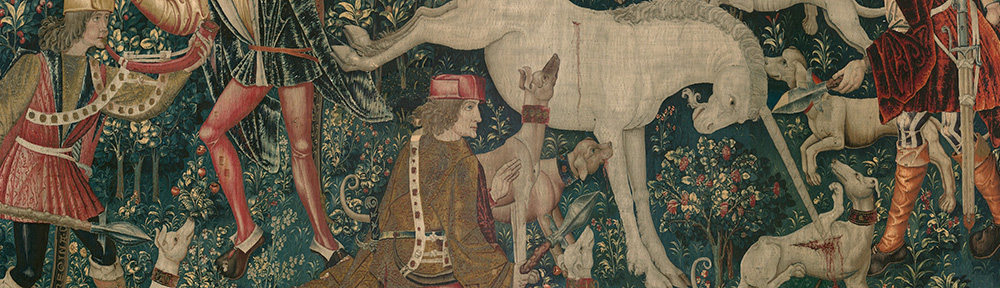
In the reading, the werewolf creature is described as a “savage beast” who devours men in his “blood-rage.” Despite the fact that the subject matter is describing a violent, flesh-eating creature, the language used to do so is poetic and beautiful. Similarly, in the tapestry “The Unicorn Crosses the Stream,” the artistry behind the piece is visually beautiful, contrasting the violent scene depicting a group of men holding spears pointed at the unicorn. These examples demonstrate how horrific violence can be portrayed as something beautiful with great creative skill.
I agree that the werewolf’s violence is rendered in a strangely beautiful way. The line, “Soon as he came, this chevalier, the man, he ran up furiously, sank in his teeth, and dragged him close”, is a vivid and brutal yet its intensity gives it a dark elegance. What makes this moment striking is its placement. It follows the royal festival, where knights and barons gather in celebration, feasting. Where the werewolf himself has been embraced with honor, loyalty, and affection by the king. That contrast heightens the effect of the violence, making it feel like a sudden rupture with in a elegant scene. To me, this scene reflected a deeper idea about human nature, how beauty and violence can coexist. The werewolves’ act of vengeance doesn’t erase his loyalty; instead, it reveals how devotion can turn to violence when trust is broken.
The wild and the civilized
⤹Click the reply button just below.
An example when the wild appears civilized is the Bisclavret’s first encounter with the king. A werewolf like figure, typically known for being wild, beastly and untamable, is uncharacteristically kissing the king’s “stirrup” (918)l. The artist shows that just something seems to be intimidating or frightening on the outside, it doesn’t mean they are internally. The artist makes it clear, we shouldn’t conflate looks with behavior.
I agree with your interpretation because that moment in Bisclavret clearly challenges the assumption that something appearing wild must behave wildly. When the werewolf kisses the king’s stirrup, he performs a gesture I would associate with loyalty, respect, and courtly civilization. This action contrasts strikingly with the expectation that a wolf-like creature would attack or behave violently.
I agree with you that we shouldn’t conflate looks with certain characteristics because the humans in that encounter don’t act like they’re supposed to either. In that encounter, the bisclavret who was the wild one, acted tame, but the humans and dogs who were supposed to be the civilized and tame ones, defaulted to savagery. When they found the bisclavret, “All day they flung themselves at him, / all day pursued, both dogs and men; / they almost had him. Now they’d rend / and tear him; now he’d meet his end” (Marie de France 141-144). The very people who appear to be civilized are displaying actions that would be expected of the bisclavret. Similarly in the tapestry “The Unicorn Defends Himself”, the humans are depicted as the savages striking the creature and the unicorn is simply trying to fight back. It further proves the point that certain behaviors and characteristics shouldn’t be assumed of someone because of their appearance. Ultimately, civilization is conditional- the second a group of civilized people encounter the unfamiliar they revert to mob mentality.
In the beginning of Bisclavret, the author describes werewolves as “savage beasts” that devour men. But then she introduces the main character as a “good knight” who is “handsome” and “all that makes for nobility.” This shows a mix of wild and civilized. I think Marie de France is saying that a person can have a “wild” side but still be a “civilized” and good person.
The Influence of Ovid
⤹Click the reply button just below.