Due Feb 17
Classical Poets on Love
Today we read a series of ancient poets on the topic of love and desire. Trigger Warning: both Hesiod and Ovid tell stories of sexual coercion.
Reading: Hesiod’s lyric poetry (~700 BCE) served, alongside Homeric epic, as the foundation of Ancient Greek culture. His account of creation foregrounds Eros (desire) as one of the fundamental drives in nature. (Hesiod-Theogony.pdf)
Reading: Sappho (~600 BCE) was celebrated in antiquity as the “tenth muse” because of the beauty of her lyric poetry. While few of her poems survive in full, we have an abundance of fragments, due to the frequency with which later writers quoted her. What’s puzzling is the cultural context in which her lyrics were performed, given the social strictures on women in Ancient Greece. Most scholars today believe she held an officially sanctioned position of some kind, whether as priestess of Aphrodite, supervisor of girls’ ritual education, or leader of a chorus of women dedicated to the Muses. (Sappho.pdf)
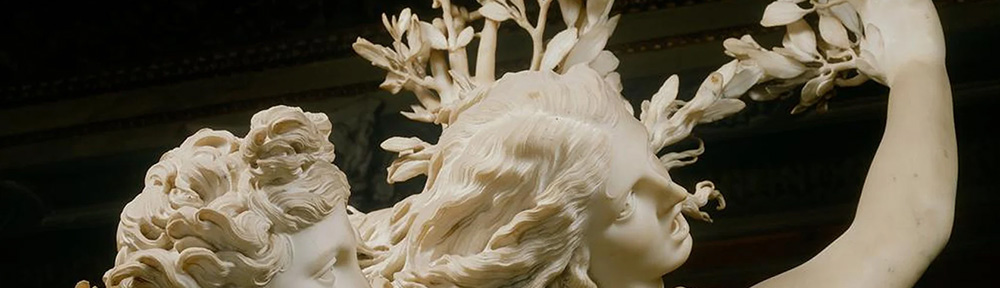
Reading: Ovid was one of the great Roman poets, whereas Hesiod and Sappho were both Greek. Born 43 BCE, he was banished to the Roman Empire’s far East because his voluptuous verse ran afoul of the aging emperor’s moralism. His Metamorphoses, published from exile in 8 CE, reworks Greek myth to present the world’s history as a seemingly endless, desire-driven sequence of changes. We are reading the story of one such metamorphosis, Apollo and Daphne. (Ovid Apollo Daphne.pdf)
Writing: Respond to ONE of the following prompts. Keep your response short, posting as a reply under the appropriate heading in the comments section:
- Hesiod’s creation invites comparison to the Enuma Elish. Point to something that the two stories have in common—or something that makes them distinct.
- Sappho is famous for presenting the first-person experience of desire. Quote a telling line or phrase and comment on the emotional experience it conveys.
- Aestheticizing violence: point to and discuss a moment in Hesiod or Ovid where beauty is mixed with or in proximity to violence. If you can, give a 1-sentence paraphrase of what the artist/author seems to be saying about the relationship between violence and beauty—or possibly art.
Further Reading: For those interested in the scholarly puzzle of Sappho, here are two scholarly pieces:
Hesiod and the Enuma Elish
⤹Click the reply button just below.
One similarity between then is that both start with primordial chaos or undifferentiated origins rather than a perfectly formed world. Theogony start mostly with Chaos, and then with Gaia, Tartarus and Eros Hesiod starts with ““First of all Chaos came to be” (Theogony 116). In Enuma Elish, the universe starts with the mingling of the freshwater god Apsu and saltwater goddess Tiamat. The cosmos emerges slowly from an unstable beginning in both showing how it is something built out of disorder. However, the difference is shown significantly in how the cosmic order is illustrated. In Enuma Elish, it started mostly with violent combat showed when Marduk slays Tiamat and then made a world from her body “split her like a shellfish into two parts”, this surrounds the kingship and power of politics, family driven unfolding of divine order. Vice versa, even though Hesiod’s narrative also involved violence (Cronus overthrowing Uranus, Zeus overthrowing Cronus), the creation of the world physically is not as much about one certain battle but more about the succession. Zeus’ rule shows stabilisation post conflict but the cosmos is not made from a slain body of a monster in the similar way.
Sappho and the experience of desire
⤹Click the reply button just below.
Sappho makes a lot of commentary on the feelings that are evoked inside of someone when looking at the person they desire. An example of this is in Fragment 31 when she describes how “it puts the heart in my chest on wings for when I look at you, even a moment, no speaking is left in me” (Sappho, Lines 5-7). The voice and laughter of the person the narrator desires bring so much delight to them that they feel free. Their heart that is stuck in their chest feels like it can fly. Subsequently, the next part describes how, when they look at the person, they go speechless and don’t know what to do. The feeling that the person evokes in them is beyond reason. Sappho is describing how desire is an experience that surpasses the realm of human possibility.
I also found this particular quote interesting as the idea of a heart with wings is similar both in literal meaning and figurative meaning to the modern statement of butterflies in a stomach. The feeling of a heart beating quickly or an upset stomach are both signs of nervousness but in this situation the saying is used to describe excitement. Sappho also mentions “fire is racing under skin” which is a common sensation of the feeling of anxiety and/or excitement. I think this poem in its entirety shows how with desire comes both feelings of nervousness and excitement and that there is no desire without the both of them.
Sappho describes all categories of desire, which include the intellectual desire, such as one’s passion. For instance, Sappho writes in Fragment 16, “Some say an army of horsemen, others a host of infantry,
others a fleet of ships is the most beautiful thing
on the black earth. But I say
it’s whatever you love” (Sappho, Lines 1-4). I believe when Sappho says it’s whatever you love, she is trying to capture all various forms of desires besides the sexual desire, but also the passion to do something or learn something or to be a part of something. So I think these lines convey a personal and broader emotional experience for readers as they can interpret it into their own various forms of desires.
Beauty and Violence
⤹Click the reply button just below.
In Hesiod’s Theogony, the embodiment of desire and beauty is literally born from “A white foam from the god-flesh…” that came from the severed genitals of Ouranos, the original god of the heavens (Hesoid 190). The other gods are birthed by the earth goddess Gaia, the primordial original mother and life-giver; it feels significant that Aphrodite is the only one to be borne of an act of spectacular violence and death, dealt by one man to another. With this depiction, Hesoid seems to suggest that violence is a fundamental and primordial force in the world that makes beauty’s existence possible. The force of Cronos’s violence against his father shapes the world in both beautiful and terrible ways, since from it springs both Aphrodite and the giants and the Furies, who are manifestations of vengeance.
I think you point out a great example of aestheticizing violence, and would extend your argument by emphasizing the poetic nature of the description. Hesiod doesn’t narrate the mutilation in graphic anatomical detail, but shifts our attention to the drifting genitals in the sea and the foam that gathers around them. The violence is stylized, illustrated through metaphor and vivid imagery. This artistic choice mirrors the myth’s main idea, that as the foam turns flesh into divinity, poetry turns brutality into beauty.
I agree with both of you, but to add on, I would like to point out the irony of Aphrodite, who is depicted in the poem as extremely divine, as seen in “Tender grass sprouted up under her slender feet. Aphrodite is her name in speech, human and divine.” The literal goddess of beauty, love, and desire, yet she is born from a vile and grotesque act of castration, and the genitals being thrown into the sea. Hesiod here might be trying to connote that desire and allure are so inseparable from violent creation that even divine beauty originates in destruction.