Due Mar 16
Medieval Christian Romance
Reading: The Lais of Marie de France (Blackboard: Marie de France, Lais.pdf)
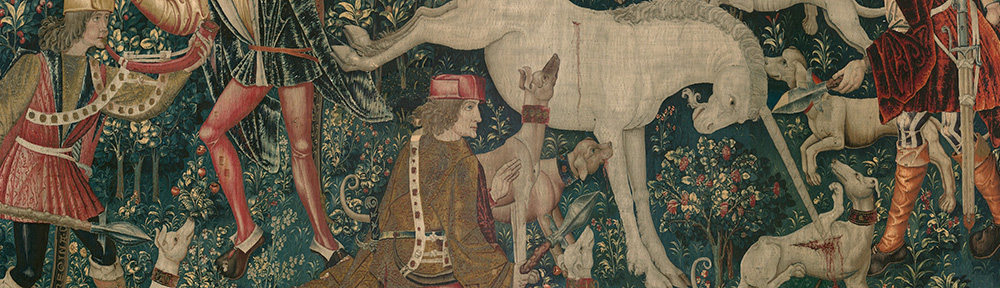
Viewing: The Unicorn Tapestries, link. (If you live or visit New York City, I recommend you see these in person at the Cloisters, an annex of the Metropolitan Museum of Art near the northern tip of Manhattan.)
Writing: Respond to ONE of the following prompts. Keep your response short, posting as a reply under the appropriate heading in the comments section:
- Aestheticizing violence: point out a moment from the works you read and viewed today where beauty is mixed with or in proximity to violence. If you can, give a 1-sentence paraphrase of what the artist/author seems to be saying about the relationship between violence and beauty—or possibly art.
- The wild and the civilized: point out a moment from the works you read and viewed today when something wild becomes tame—or something tame/civilized becomes wild. If you can, give a 1-sentence paraphrase of what the artist/author seems to be saying about the binary opposition between wilderness and civilization.
- Ovid exerted a tremendous influence on both art and literature in the Middle Ages. Point to a detail in either of today’s texts that offers evidence of this claim.
Violence and Beauty
⤹Click the reply button just below.
Violence and beauty appears in Marie de France’s Laüstic when the husband kill the nightingale, symoolizes the love of the wife and her neighbour. The husband violently breaks the bird’s neck that “bloodied her breast a little bit”(Marie de France), but later she “She found a piece of samite, wrought with gold,”(Marie de France ) before she sends it to her lover, both samite and gold represents softness of their restrained love. These luxurious materials especially gold, represents delicacy and value of their restrained love since their their opportunities to see each other are precious and scarce. Similarly the beautiful piece of silk contrast with the violent act of the husband “with his two hand he broke its neck…”(Marie de France) this highlight how covering the wounded bird with fine fabric, the lovers attempt to save their fragile remains of their relationship. Violence here is the tool to foil the beauty behind every pain that they have to go through, transforming it to something memorable.
I agree that the killing of the nightingale suggests that beauty and violence are closely connected because acts of cruelty can expose how fragile beauty and love really are. The bird represents the lovers’ peaceful and beautiful connection, but the husband’s sudden violence destroys it. By placing this violent moment next to the delicate image of the bird and the luxurious cloth used to wrap it, the story implies that beauty often exists right beside violence, and that human jealousy and control can easily shatter something pure and delicate.
Violence is seen to clash with beauty through the tapestries of the unicorn. As the unicorn can be seen as something so mythical, magical and beautiful, yet that very beauty is what caused the hunters to seek to kill the unicorn, bringing in violence. In self defense, the unicorn must also harm the dog in the tapestries, leading to even more violence. So here the unicorns beauty works as a double edge sword and directly links it to violence. This creates a perplexing and counterintuitive loop between beauty and violence.
The wild and the civilized
⤹Click the reply button just below.
The wild and civilized are often connected throughout Marie de France’s poem Bisclavret, specifically when the king sees the bisclavret for the first time and decides to bring him to the castle. The king sees him for the first time while hunting, and he unleases hunting dogs to kill the werewolf. As an act of preservation, “his eye, distinguishing, could see the king; to beg his clemency he seized the royal stirrup, put kiss upon the leg and foot” (Lines 145-148). This action saves him, as the king recognizes his humanity through it. A werewolf is a mix between the wild and the civilized, as it is half animal and half human. While at this moment, the bisclavret looks like a wild beast, his action of kissing the king’s foot shows how he has a human-like quality to him and possesses civility. Perhaps the author is trying to say that true civility is determine by internal qualities, rather external visualities. Something that looks wild, can be civill, like the beast; while something that looks civil, like some deceitful humans, can actually be wild.
Yes, I agree that the werewolf is a mix between the wild and the civilized but compared to the beginning or middle of the Bisclavret poem, I think it’s important to note that in the beginning the author tries to illustrate to audiences that the bisclavret is human, that is something that goes from civilized to unclivized but then later on goes to demonstrate how the wild becomes tamed or cilvilzed again. An example of this is when the author states, “He loved the wolf and held it dear, and he charged every follower that, for his love, they guard it well and not mistreat the animal” (Lines 169-172). I think there’s great significance behind this because the author must’ve wanted to draw readers’ attention to the battle between human and inhuman while also demonstrating the journey of the bisclavret from the beginning to the end.
The Influence of Ovid
⤹Click the reply button just below.
I think Ovid’s influence can be seen as both stories show love as a destructive force. In metamorphoses, love causes Apollo to chase Daphne until she is forced to be turned into a tree to get away from him. In the Lais, love between spouses turns destructive when it’s betrayed. Bisclavert “tore her nose of, then and then” upon seeing her due to his rage from her betraying him. This shows how love can cause chaos and discord very easily just like how it did in Ovid’s story.
I agree, and additionally I also think both the Lais and Metamorphoses portray the specific brutality of denied male desire. Daphne fears Apollo and his desire and spurns him, but he persists in his pursuit of her, prompting her extreme and almost violent transformation. The wife in Bisclavret fears her husband, so she flees from him and traps him in werewolf form, leading to him eventually brutalizing her and tearing off her nose. The wife in Laüstic denies her controlling husband her presence at night by telling him she listens to the nightingale, so he traps it and, “in rage, with his two hands he broke its neck” (Lines 114-115). In all of these stories, the destructive force comes from male desire scorned by its female object, who then experiences violence in some form because of her denial.