Due Apr 15
Enlightenment Satire
Viewing: two moral satires by William Hogarth:
- A Harlot’s Progress (1731-1732)
- A Rake’s Progress (1732-1734)
Reading: Voltaire, Candide, Chs 1-14 (pp 1-47)
Writing: Respond to ONE of the following prompts. Keep your response short, posting as a reply under the appropriate heading in the comments section:
- Finding the funny: Hogarth’s engravings can feel a bit preachy, but they’re filled with humorous details. Draw our attention to a key detail and comment. (Feel free to attach a closeup image of the detail you’re interested in.)
- Finding patterns: a lot happens in Voltaire’s satirical novel; help make sense of the chaos of events by noting a pattern, something that happens repeatedly.
- Progress: what sort of “progress” happens over the course of Hogarth’s image series—or Voltaire’s novel? Cite a particular detail from one of these three “texts” as example or illustration.
Finding the funny
⤹Click the reply button just below.
A detail i found somewhat humorous was the detail of the pans falling over in the “Arrival in London” engraving. The falling pans serve as a rhetorical “alarm” for the shift in Moll’s journey; going from a country girl, to a “fallen” woman, like the pans indicate. Hogarth is demonstrating how people can be oblivious to their own demise, as she is unaware of the loud crash which is soon to occur.
I agree that this detail signals a change in her identity as a woman. Her obliviousness to falling pans may also symbolize society’s unstable foundations, which most people ignore. Despite London’s outward progress, it was marked by severe wealth disparity, which ultimately pushed the harlot into prostitution. I think that the pans may indicate a bigger societal issue than just the woman.
Attachment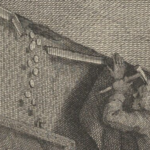
From The Inheritance in A Rake’s Progress, I found it funny that coins were falling from the ceiling. There is a person hitting the line between the ceiling and the wall, and there is a hole from which items are falling. It initially looked like dust or bugs, but dust is far too diminutive to look like that. Besides, I didn’t see any limbs on it, so it couldn’t be bugs. The only other option that came to my mind was coins. There were coins raining down from the ceiling.
I also found this detail very interesting because this scene depicts the inheritance of money this man gets, and the notion that money is just “falling from the sky” is quite literally shown through this portrait. I find it interesting that nobody but the man working on the ceiling is noticing this even happening, and I think this might tie to the idea that people don’t think about where the wealth is coming from, more of the person you holds it. Also, everyone’s attention is solely on the man this portrait depicts, and these little details of coins allow us to see, from the artist’s perspective, the “hidden” or unacknowledged aspects of his life.
one detail that I find very interesting is in A Harlot’s Progress by William Hogarth. This scene seems to be less chaotic compared to the others, yet when we look closely, the scene portrays the tragic events of Molly, which is presented in a courtroom, supposed to be a place full of seriousness and formality. On the left side, we see 2 dogs randomly mating in peace. This almost seems to be a bit sarcastic, as it makes the image more ridiculous. This contrast of the life of Molly, which is falling apart in tragedy, yet the presence of the 2 dogs is separated from all the others as they are just doing their own thing. Further, the fact that one dog is higher than the other depicts exactly the same position as the humans when the judge is at a higher position, almost mirrors the human hierarchy in the scene. It is perhaps a small visual joke, however also reinforces the power difference in the room. The artist seems to be mocking the seriousness of the court by paralleling it with something crude, the dogs, happening right next to it.
Finding patterns
⤹Click the reply button just below.
Finding Progress
⤹Click the reply button just below.
Over the course of each of the image series, the main subject is depicted as having something “positive” happen to them in the beginning. In “A Harlot’s Progress,” for example, the main subject arrives in London and is dressed very nicely, implying she is of higher status compared to the woman greeting her. As her time in London continues, however, she is placed in increasingly precarious situations, with the number of mouches, or the black beauty marks, on her face increasing, hinting at her contraction of syphilis. This paired with her clothing, which becomes more common with each painting, symbolizes her lifestyle change, implying a downward spiral up until her untimely death. Both of the image series end with the subject losing all they had at the beginning. If I had to guess, I would say these paintings suggest the common folk were seen as being unequipped to handle noble status and wealth appropriately and, when they were granted wealth and power, they mishandled it and lost everything. These paintings seem to be poking fun at the lower classes.
Over the course of both “A Rake’s Progress” and “A Harlot’s Progress” we see beautiful and vital young people fall into what was considered “sin” and face punishment from both society, in the form of the courts, and also presumably from God, in the form of madness and illness. I find it striking that the faces of both youths at the beginning of their “Progresses” appear almost angelic in their young and unspoiled facial features. In both scenes, this unspoiled beauty is starkly contrasted by the aged faces that surround them, many of whom have expressions of speculative greed, as if measuring how much value they can wring from the youths. This seems to imply that both of these young people were enticed and led astray by people who were already corrupted. I find this interesting because it establishes a theme consistent across each “Progress” which is that its subjects are treated with both pity and mockery.