Due Jan 28
Sacred Spaces, Holy Hours
Reading: Strickland, pp2-11. (“Strickland” refers to one of the books on order at the BU Bookstore, The Annotated Mona Lisa, by Carol Strickland.)
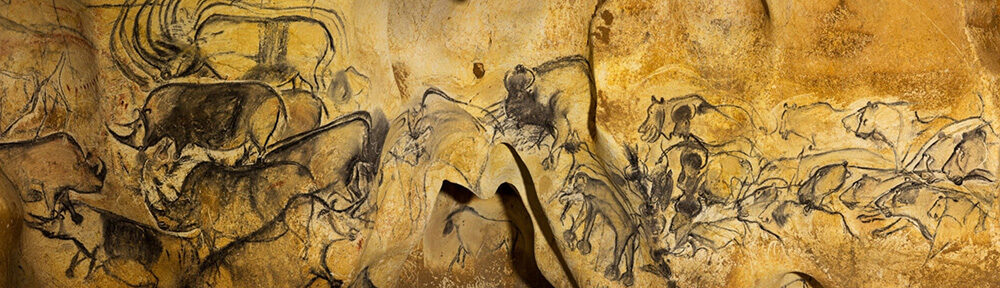
Documentary to watch: Herzog, Cave of Forgotten Dreams: link.
Video to watch: “New Light at Newgrange,” published to YouTube by the Irish National Monuments Service.
Writing: Read HW guidelines linked here. Then respond to ONE of the following prompts. Keep your response short, posting as a reply under the appropriate heading in the comments section:
- In the first 10 minutes of his documentary, Herzog focuses a lot on his process (i.e. what it was like to move about and film in the cramped cave), rather than on his subject, the cave paintings themselves. What purpose does this serve? In answering, point to a particular moment or (better) quote the film’s narration as evidence of your insight.
- Several times Herzog’s documentary presents evidence that bears hibernated in this cave. In what way is this relevant to the human practice of decorating the cave with art? You’ll have to speculate to answer this question, but bolster your hypothesis by pointing to specific evidence from the film where evidence of early humans is juxtaposed with bear sign.
- About an hour in, Herzog makes reference to the culture that produced the Venus of Willendorf. Name one key way in which that art differs from the Chauvet cave art—and speculate a bit about what this suggests about those two cultures’ differences. Try to ground your speculation in visual detail!
Further Reading: After attending lecture, if you want to learn more from the sources that informed my analysis, here are two key authors, Harari and Eliade, indexed by idea. Selections from both authors are available on Blackboard.
- The “Cognitive Revolution”: Harari pp1-12
- The “Agricultural Revolution”: Harari pp12-18.
- Shared fictions/imagined orders/myths as fundamental to human culture, inescapable “prison walls” that shape our thinking: Harari, pp18-30.
- Hierophany: Eliade.
Why does Herzog focus on his process as documentary filmmaker?
⤹Click the reply button just below.
Herzog choosing to focus on his process as a filmmaker before talking about the actual subject itself, puts him and us in the same framework as the art, giving it more importance to the viewers. Him telling us how he and his crew only have a few hours in there and showing how dark and tight the cave is gives more context on the setting in which the art is in, and shows just how hard it is to actually view the pieces in person today. This makes it so that when he starts talking about the art itself, it is more powerful, and we view it in a different way than we would have before, not knowing the context of what it takes to actually get there.
I agree with you that Herzog focusing on his process makes the reveal of the art more powerful! However, I also think that part of the focus is Herzog taking pride in his art form. It seems like everything in the cave is challenging – they have very little time and because they are stuck on a tiny metal walkway, there’s nowhere for the “film crew to hide outside of the shot”. Despite these harsh restraints, Herzog forged ahead, and even made things more difficult by deciding to shoot the cave in 3D, which was still new and difficult to work with at the time. Without Herzog sacrificing so much time and energy to produce this film, most of us would never get the chance to see these paintings in this level of detail. The first part of the film celebrates him overcoming these massive challenges so these wonders of prehistoric art can be shared with the world.
I agree with you that in Herzog’s process of showing us the obstacles it took to film these pieces of cave art, viewers can appreciate the art more and broaden their perspective as to how hard it actually was to share this artwork. Understanding that the amount of effort it took to just be in the space alone gives the audience a sense of privilege to be able to experience the art with Herzog and his crew. Although I agree with you that focusing on the initial process may help add to the importance of the art, I think the reason he may have focused on this section was more to express how the limited access to the cave has made it more difficult to publicly display this tremendous discovery, and how the structure of the cave itself has changed over time. In the documentary, it was mentioned that only on certain days per year were a select number of scientists allowed to visit in order to prioritize the preservation of these paintings. Not only this, but because the trees standing on top of the cave produced so much CO2 through the porous rock, the time they could spend in the cave was also very limited. With the ground being very fragile as well, even recording certain parts of art was extremely hard to do without damaging the cave (such as the woman/bison painting). With all of this in mind, I think it sets the context for how important these clips of the cave are to our modern society and study of civilizations back in the day, using modern technology. After the landslide of the rock, access to the cave became even more limited, Herzog mentions, and it is now harder to get into the space than it used to be. Many of us will never be able to see this cave in person, so this film has allowed the general public to admire and study this relic of history, even with such limited access.
I agree with you that Herzog talking about the process of being able to visit the art gives us a better perspective on how important this art piece actually is. I think that this is shown when its said that the only a small group of scientists were allowed to enter. However, I also think that this goes to show the scope of how much of a privilege it was to be able to not only visit but also film the art with how many restrictions and obstacles were put in place. The caves were made with the intent of letting as little human interaction possible, putting a metal door over the entrance immediately to lock of the area from the outside world. Him spending the first 10 minutes on only the journey shows how due to his efforts, the general public is allowed to understand and study this important relic of the past.
I agree, and to add on, I think the way the depiction of the filmmaking process not only puts us and him in the same framework as the art but also puts both himself and his audience into the lineage of artists and viewers that have experienced and contributed to this art in different ways for the past 30000+ years. The general public may no longer be able to physically add on to the art on the cave walls by painting, as was done for thousands of years, nor be able to view it completely unobstructed in person, as was also the normal mode of viewing it for thousands of years. However the documentary as a piece of art in itself is a modern contribution to the art of the cave, in a new medium that allows us the audience to experience the art in a modern way. In this way, the art of the cave remains a living and continuous experience/collaboration across the eons and brings all of us into that experience.
I agree with you that Herzog chose to focus on his process as a filmmaker before discussing the paintings themselves because it allows us, the audience, to gain a deeper understanding of the setting of the paintings and the perspective from which they are seen. Also, Herzog says, “Inevitably, moving along in single file, the film crew will have no hiding places to get out of the shot.” When Herzog says this, he is trying to make the audience appreciate the journey it took to get there, but also the difficult constraints they had while filming the paintings and the cave.
Herzog focusing on his process as a documentary filmmaker puts us directly in his shoes, at least during the documentary. By starting where he starts and following his journey in a raw and honest way, seeing different things like new art when the outside of the cave seems like nothing special makes everything feel much more emotionally charged. The significance of the art is much more present with Herzog’s film style compared to just seeing pictures or videos of the art by itself.
I agree with Zaid that Herzog wants us step into his shoes so that we can see what significance the art holds. I think A particular reason that he is doing this would be to show us the lengths that people like him need to go to preserve art. We can see how tight and dark the cave is when they first enter which allows us to have an appreciation for this art even more as we know the strugglee it was for Herzog and his team to film. This created greater appreciation for both these painting as well as other art that needed to be found and accessed in other difficult manners.
I agree with both of you that Herzog wants to highlight the importance of the art and how significant of find this was to the world. Herzog establishes the cave as a fragile and restricted sight that feels scared rather than as a place of art. By emphasizing the rules and regulations following the restriction of access to the gave it furthers our understanding of significance and allows us to view the art with restraint. Herzog’s approach reminds the viewer that this was a physical space and is to be experienced as such, rather than a string of paintings, overall increasing the significance.
I agree with you that Herzog does this to put you in his shoes, and I also believe he does it specifically to emphasize how fragile the artwork is. He documents how you can’t touch anything in the cave and that you have to walk on a small platform instead of the cave floor. All this makes the art seem easily destroyed. Then the art feels more intimate and fleeting. Think of all the work thats lost to erosion, and think of all the time thats passed! It feels, like you said, that the art is more raw.
I agree that focusing on the process puts the audience directly in his shoes and in doing so, he extends the experience to the viewer. As Herzog said himself in the documentary, he was given rare access to film in the cave which means that very few people are allowed into the cave to begin with. As a result, getting to experience the paintings in their entirety is simply not accessible to the average person so by focusing on what it was like to get into the cave and maneuver around before showing the paintings, Herzog has now made the experience accessible to just about anyone. He has turned it into an individual experience that can be enjoyed from the comfort of one’s home without actually having to do the work of going to the cave or maneuvering around in it, similarly to how we’ve commodified and publicized other icon works of art into highly individualized experiences like the Mona Lisa.
I agree with you that Herzog wants us to see the importance of the caves from his perspective. To add on, I also think he wants us to understand how important the trained scientists are, the limited amount of time they have, and the number of rules they have to follow. The carefully crafted film that Herzog made not only shows us the fragility of the cave and its importance, but also the amount of care that goes into studying it. By explaining to the audience that “Only a small group of scientists are allowed to enter,” archaeologists, art historians, paleontologists, geologists, etc., it shows the audience the amount of tedious hard work and skill it takes to study such a beautiful work of art. Herzog allows the audience to appreciate all the work these scientists and researchers do.
I believe that the emphasis on the process, that was seemingly so arduous is to display the importance and impact that the cave paintings have. With something as transformative and revolutionary to our understanding of past humans as fully preserved cave paintings, Individuals such as Herzog and the exploration teams are willing to trek great distances and go through difficult passages to unlock the secrets of the past. I believe that Herzog, in showing up this process, gives the viewer insight into just how important these cave paintings are–despite the restrictions and limitations placed on the crew exploring the cave, they went to great lengths to get the footage and show the world a glimpse of art from tens of thousands of years ago.
I want to add on to what Zaid was saying, and say that I agree with you, and I wasn’t originally looking through the lens of wanting to allow us to “step into his shoes”. However, the more I think about it, the more I realize that yes, by having us “step into his shoes”, we will get a much more emotionally intense and focused view of the paintings–as opposed to as if the documentary consisted of pure description and no first-hand experience was offered.
Herzog focuses on his process early in the documentary to clearly show that his documentary in the cave is unlike anything he’s done before in his career. The sweeping orchestral music plays a part in this but Herzog’s explanation of why he can’t film the cave as he does other things is the main reason why the Lascaux caves are so distinctly different. They’re more restricted than anything he’s ever been too. I’ve seen other Werner Herzog documentaries and he never details his technical approach to this degree because he doesn’t need to and it would also take away from what he’s shooting. Inviting us into his world as a filmmaker while he’s inside of the caves only adds to their grandeur because of how different it is to properly film inside.
Prior to the documentary linking to the subject—the caves—there is a process shown. Herzog shows us watchers how hard it is to actually access and witness this cave first-hand. In a way I link this to the psychological saying of “people want what they cant have”. Showing the obstacles to actually reach this cave exerts the precariousness of this cave. Herzog mentions how “We are only allowed to use the existing light… and we have to move on a narrow metal walkway.” This shows the audience that what we are about to see aren’t freely captured—they are hard-won. Ultimately, this process shows not just the ancient artifacts, but how they are fundamentally inaccessible. (I posted in wrong spot)
Herzog’s initial focus on his process as a documentary filmmaker, specifically in the Chauvet Cave can be used as a tool to build the wow factor and significance of the interior art of the cave and rarity of the film documentation itself. By describing the difficulty of what it took to create the film it emphasizes the importance of the art inside the cave and the film. At one point when Herzog talks about how they were only allowed to be in the cave a few hours a day because access was so limited and the cave is in a fragile state of balance. This framing helps remind the viewer that these places are not meant for human presence and ties in the themes of preservation and humility in respect to things far older and more vulnerable than ourselves.
I agree with your point of the initial focus adding a certain wow factor to the interior art in the Chauvet Cave as it almost allows the viewer to understand the rarity and difficulty in gaining access to this sort of art. With the filming group being “limited to a maximum of four,” the viewer is able to understand the struggle in recording this piece of history and sharing it with the world. This portrayal also helps display Herzog’s perspective and how much he cares about the cave art. This in turns leads to a bigger argument on the reason that he focuses so much on the process is to shed a light on the sacred nature of this art. Due to its many restrictions and limitations, he is in turn proving his dedication to the form. I also believe he makes it so much more personal by letting us see the process he had to take that led him to be able to showcase these works of art. I also believe that in including this segment into his documentary, Herzog is able to turn the tables and remove the exclusive nature of who was able to view this artwork in the past and make it accessible to all people. In this way, further preserving this artwork from ten thousand years ago. The way Herzog described how rare it was to be able to film inside the cave itself (due to the cave’s structural fragility) adds to the dedication that he has to portray how important it is to have these snippets of history in documentaries.
Herzog’s focus on the actual process of entering and exploring the cave really gave me a better understanding of the significance of the artwork. If he only talked about the cave painting, it would be easy to lose sight of how impressive of the feat this actually is, which is a work of art created over thousands of years underground that needs to be preserved. In my opinion the cave paintings could be seen as just another work of art, if that is all Herzog focused on. All the safety precautions needed to traverse through the cave, and the gear necessary to travel down the cave made me question why people would go down this cave just to sketch down animals.
Herzog’s focus on the process of filming in the first ten minutes rather than the painting themselves, emphasizes why the paintings are so extraordinary. By drawing attention to the cramped, dangerous conditions of the cave, he highlights the effort and intention behind the paintings themselves. The harsh environment of the paintings, proves that they were not made casually or for public display. Herzog notes, the cave is “barely accessible” and movement inside is extremely limited, which highlights how deliberate the act of entering the cave must have been. The people who created these images did not have written or oral language to record their myths, so they created figurative drawings in a preserved space to do so. Because the paintings were made far from natural light and not easily accessible, they were likely not intended for everyday viewing or preservation. By emphasizing the process first, Herzog sets the stage for understanding the paintings as intentional, meaningful acts rather than simple decoration.
Significance of Bears in the Cave
⤹Click the reply button just below.
In addition to the paintings humans created on the cave walls, the documentary focuses on evidence that other animals that resided within the caves, like hibernating bears. The ground beneath the paintings is littered with bones and animal remains with teeth marks left behind by bears, hyenas, etc. This very clearly demonstrates how dangerous it was for humans to enter these caves, making their artwork that much more meaningful. Early humans went to great lengths to document the things they had seen, tell stories, and to leave their mark on this earth. I feel this proves these paintings had great cultural and personal significance to the early humans and didn’t just serve as ways to pass the time or entertain themselves.
I agree with Sophia that the art being on the cave walls that the bears hibernated emphasized how meaningful storytelling and art was to humans. The documentary describes how it was extremely dangerous to enter those caves so the paintings proved how skillful these artists were. I also believe that humans painting in the caves with bears in them acted as some sort of achievement to demonstrate how knowledgeable they were. It proved that they understood animal behavior and the area well enough to risk going in there.
At the beginning of the documentary, Herzog talked about the several scratches that were printed beside the human painting. These marks might explain why people painted in the cave. It is possible that the early humans had learned from the bears, whose scratches were found elsewhere in the cave. The scratches could be the initial painting in the cave, then practiced by early humans. He also mentioned that people painted at the end of the entrance in the dark, which could mean they wanted to record something sensitive or personal. The scratches could have led early humans to learn how to record long-lasting images they wanted to remember, which showed the important role of the bears.
I agree with Mia, and to add on, bears could have been an animal that the people made a symbol. The documentary mentions that the people painted and also held ceremony’s in these caves, showing there was clearly a significance to the people here. It would be strange to host such events in such a dark muggy place if not for a particular celebration. With this information, we can suggest that the bears could have been an animal that these people praised or looked up to, just like numerous cultures today, ceremonies in a cave with hibernating bears would be extremely symbolic.
In addition to what Mia said, I think humans painted in the cave to “mark” these caves as having been there. I noticed that most of the paintings looked similar, which feels like the later painters were inspired by the previous paintings, which is why they looked similar.
Chauvet Paintings vs the Venus of Willendorf
⤹Click the reply button just below.
As we discussed previously, the Venus of Willendorf was crafted by a nomadic peoples as a religious totem to grant the owner who wore/transported it values associated with femininity, such as fertility and ideal body proportions. The small size of the totem suggesting the totem moved with the people who owned it and took part in daily happenings. Meanwhile, the difficulty inherent in transporting the Chauvet and its cave paintings, when combined with the understanding that the creators of the art were nomadic, suggests the site was not active as a religious site for prolonged periods of time. In addition, the movement included in the art suggests the works were used as a means of socialization through storytelling. Meaning that these two constructs served entirely different societal roles and that each people had a different relationship concerning their approach to religious practices.
I agree that while the Venus of Willendorf clearly traveled with its owners. The Chauvet cave paintings might also have functioned as spiritual or religious paintings but not in the way one might expect. It could be seen as an extraordinary experience to enter the cave : a rare but extremely special and sacred journey, that connected humans to their environment (animals, ancestors and the unseen world). In this aspect, both the Venus and Chauvet art served a spiritual purpose but one just did so intimately and constantly while the other did so powerfully and less frequently.
One key artistic difference between the Venus of Willendorf and the Chauvet cave art was the subject matter and what the art represented in each society. The Chauvet cave art was composed mostly of animals, emphasizing movement and storytelling; humans are almost completely absent from the drawings. The art studies animals as active beings in a dangerous landscape. Meanwhile, the Venus of Willendorf depicts a female figure with exaggerated anatomy. A woman whose face is obscured, making the totem obviously symbolic to what the figure represents. I think that the Chauvet art places meaning into the environment (animals in motion), while the Venus art places meaning into the human body (fertility, nourishment, etc.). So the contrast isn’t just in their styles, but their societies’ worldviews.
The Chauvet cave art differs from the Venus of Willendorf in that the cave art depicts the general observations and surroundings of the people who created them, something tangible, real that they saw and were then able to recreate through art. While the Venus of Willendorf depicts a fictional or dreamed up being, an ideal that they have most likely never seen, making their art intangible to the natural world. So what can be inferred from this is that the culture that made the cave art more so values or perhaps worships what they have been able to observe in the natural world, rather than valuing the virtues of imagined spirits and gods as is suggested by the Venus of Willendorf’s culture.