Due Feb 4
The Contrasting Art of Two Ancient Empires
Reading: Strickland pp 6-11: the art of ancient Mesopotamia and Egypt
Reading: Joshua Mark (World History Encyclopedia), “A Brief History of Egyptian Art”
Reading: British Museum, articles on the Assyrian Empire and Ashurbanipal, both written in connection with a 2018 exhibit. (The first was written by curator Gareth Brereton; the second is unsigned.)
Optional: for additional information on the Assyrians, check out British Museum articles on the library and palace gardens of Ashurbanipal. (The first of these articles was written by curator Jonathan Taylor; the second is unsigned.)
Viewing:
- Museum of Fine Arts Boston highlights from Egyptian Art.
- Museum of Fine Arts Boston, highlights from Ancient Near Eastern Art.
- British Museum virtual tour of reliefs from the palace of Ashurnasirpal (walk forward between the two lamassu and down the long hallway, until you come out the other end).
Confused? I’m also struggling to keep straight the difference between Ashurnasirpal and Ashurbanipal. –nasirpal came first, followed 200 years later by –banipal. –banipal is the scholar-warrior whose library preserved key Babylonian texts like the Enuma Elish and Gilgamesh. But -nasirpal’s palace was better preserved (link) than -banipal’s was (link) so when the British Museum tries to reconstruct what life was like for the more intesting scholar-warrior -banipal, they make use of artistic reconstructions of -nasirpal’s palace (link).
Writing: choose one of the artworks on display in the Boston MFA’s Egyptian or Ancient Near East galleries (linked above).
- Download the image to your computer, then add the image to a comment you post.
- In your comment, use what you learned from the reading to comment on the artifact: “This stylus is unusual for the Middle Kingdom in that …” or “This bas-relief is typical of Assyrian decorative art in that ….” Include a parenthetical page ref.
- Before posting, check to see if someone else has already commented on the same artifact; if so, post your response as a reply to theirs, whether in agreement, in disagreement, or by calling attention to a different aspect of the same artifact. Don’t bother to attach the image a second time.
Attachment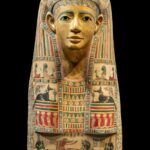
The art piece I chose was Funerary Mask created in A.D. 1-50. An Egyptian funerary mask was used to protect the head and chest of a mummified body. This piece is ornately decorated with paintings to depict the ideal image of a person. While it is beautifully decorated, the actual sculpture of the face is very expressionless. This was because “the Egyptians recognized that emotions are fleeting and one would not want one’s eternal image to reflect only one moment in life” (Mark par. 14). The Egyptians understood that humans face various emotions throughout their lifetime and wanted their final resting face to be one that captures their entire experience rather than one emotion.
Mark, Joshua. “A Brief History of Egyptian Art.” 30 May 2017. https://www.worldhistory.org/a.....ptian-art/
I agree, and also think it is important to note that this piece was created after the time of Ancient Egypt, and instead was created during the Roman Imperial Period. An Egyptian definitely created it, which can be seen through its expressionless face and art style popular in the Middle Kingdom Period, but it also incorporates some newer styles not typically seen in much of Ancient Egyptian Art. Like how “Romans would draw on the older Egyptian themes and techniques in adapting Egyptian gods to Roman understanding” (Mark para. 25), it seems like the Egyptian who made this was doing the same. The face seems a little more natural and real compared to other more unvarying depictions of the human face found in other Ancient Egyptian Art. Art styles might constantly be changing, but we can always look back and see the foundation that our predecessors left for us.
I really like the Funerary Mask since it has so many small details. As mentioned before, the expressionless face reflected the entire life experience. However, the side of the mask has so much valuable information that it also tells us about the time. The side of the mask has a view of the afterlife, as mentioned in the text, “Artwork in tombs continued to reflect the traditional view of the afterlife, but literature from the time questioned the old belief and suggested that one should concentrate on the only life one could be sure of, the present” (Mark). We see that the front of the face represents a modern twist of emotion. Whereas the sides still have traditional images of the afterlife. We see how, during this time period, there was debate of maintaining long held beliefs and embracing a new way of thinking.
I agree, not only do the sides show it, but also the bottom of it as well. It shows despite the advancement of art on the face, there is still connection to their gods of the past. It is also a great representation of the mixing of some of the cultures. The Romans were the ones who made art more realistic and human looking, and this looks like it was influenced by that art. Slowly, other cultures were integrated into Egyptian art, but they were able to stand firm with their foundation.
I agree with your interpretation of the funerary mask as this reflects how Egyptians truly valued time and identity. By making the face calm and expressionless, the artist avoids freezing the individual in a single, temporary emotion. Joshua Mark explains how “emotions are fleeting and one would not want one’s eternal image to reflect only one moment in life but the totality of one’s existence.” In a way, this portrait reflects how this mask wasn’t supposed to be a realistic portrait, but a timeless memory of one.
Attachment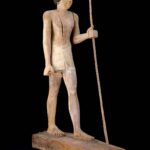
The piece I chose was the Statue of Wepwawetemhat created around 2000 B.C.E, so during the Old Kingdom. The statue is of “the venerated one, Wepwawetemhat, and shows him in the traditional pose of an Egyptian dignitary, with his left foot striding forward (MFABoston)”. This statue is unusual for the Old Kingdom in that the statue is made of wood, and has a slender, projecting staff. According to art historian Carol Strickland, “Since statues were intended to last eternally, they were made of hard substances like Granite and Diorite. Whether standing or seated, they included few projecting breakable parts.” (Strickland 9).
It’s possible that since this tomb was for a minor official (MFABoston), his offerings would have been lower quality than other, more high ranking members of society.
I agree with Daniel in that this statue is unusual for being created during the Old Kingdom because it was made of wood. Many of the pieces, specifically Shabti dolls, were said to be “important funerary objects which were buried with the deceased and were thought to come to life in the next world and tend to one’s responsibilities” (Mark). Given that this particular statue was made of wood, it normally reflects that it was made in the First Intermediate Period and for mass production. I think the fact that it was made of wood instead of stone, which would last, during the Old Kingdom, speaks to the status or position in social hierarchy the person it was buried with was in. I find it very interesting that the expression of this young man was not emotionless, but rather his slightly arched eyebrows and well-preserved eyes conveyed his “youthful intensity and energy” (MFA Boston). This directly contrasts the common practice of Egyptian art which, “is famously expressionless because the Egyptians recognized that emotions are fleeting and one would not want one’s eternal image to reflect only one moment in life but the totality of one’s existence” (Mark). With this statue displaying his emotions of the “present”, I think it gives great insight onto the kind of person this boy was, and the wood points to the lack of social status he had.
I noticed that the statues were made of granite and diorite because they would last long, and the implication is that wood (which this statue is made of) wouldn’t last long. We now know that this isn’t true because the statue was created about 4000 years ago and still exists today.
I agree with your point on the tomb being for a minor official, as I think that the work of this statute during its time is very common. Joshua Mark explains how, “during the Old Kingdom…statuary remained static for the most part.” Its also said that high ranking officials used to dictate the style of pieces of art, so that might be why its only made of wood instead of granite or diorite.
I agree with Daniel I think that one of the more interesting parts about this statue is the unusual use of wood as a material for creation during this time period. Wood was used for mass production of goods during the First Intermediate Period, so this suggests that this statue is possibly of lower quality and belonging to someone of lower status. I also find it interesting that the Egyptians believed the wood pieces would not last and therefore stopped using wood, although it may have been an easier choice and we can see today that those pieces did indeed last.
Attachment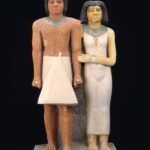
This painted limestone art piece is carved around 2465–2323 B.C.E. The little statue is a couple who had copied the royal family’s pose (MFABoston). It is made during the Old Kingdom period, which explains its poses and expression. According to A Brief History of Egyptian Art, Mark mentioned that “the king or a high-ranking nobility commissioned a piece and also dictated its style,” which unfolded the traditional pose the man is standing and their emotion less emotional facial expressions. This is a classic example of Egyptian artwork under strict control. Also, the human figure is the most common subject in Egyptian art history. The sculpt will focus on “a front view of the eye and shoulders and profile view of head, arms, and legs” (Srickland 9). The attached work presents the front view of a human figure, another classic expression of Egyptian art.
Attachment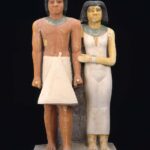
After reading, the article, “A Brief History of Egyptian Art” by Joshua J. Mark, I was immediately able to recognize that the Egyptian art piece of Ptahkhenuwy and his wife had originated from the Old Kingdom time period, (c. 2613-2181 BCE). In the text, Mark states, “Art during the Old Kingdom was state mandated which means the king or a high-ranking nobility commissioned a piece and also dictated its style (Old Kingdom Art). So, much to Mia’s point, the fact that Ptahkenuwy was a supervisor of palace retainers, the correlation between his status and the fact that nobility commissioned art during this time, remains true (MFA Boston). To add to what Mia was explaining, the garments and jewelry that Ptahkenuwy and his maiden are wearing reflect that of those from the Old Kingdom time period (MFA Boston). With these items being states, I agree with Mia Chen that this artwork is a great representation of Egypt’s Old Kingdom Art.
I agree with Mia, because of the pieces inception dating from the Old Kingdom timeframe, it expresses the fundamental message behind this time periods art in a very straightforward manner. With monumental works being created in this time period, like the sphinx, or the Pyramid of Giza, art was undergoing a grandiose transition phase. As Joshua J. Mark points out in his article “A Brief History of Egyptian Art” “a strong central government and economic prosperity” allowed for works to be intricate, detailed, and larger scale. While this piece surely isn’t of considerable size, it’s level of detail is worth noting, everything ranging from the toes to the headpiece displayed noteworthy levels of craftsmanship and attention to detail. Adding on to Aaron’s point, what makes this piece a great reflection of Egypt’s Old Kingdom Art is how it showcases gender roles. The male takes a forwards position with his arms by his side, while the female seemingly takes a more passive role holding onto the man. Because it is revealing societal norms along with techniques used in it’s creation, this piece is a standout in Egypt’s collection of Old Kingdom Era art.
I agree with Mias interpretation of this artifact.The main intention behind this piece is clear at first glance, with the level of detail making it clear that this artifact was created during the Old Kingdom timeframe (a transitory phase for art where pieces became more and more detailed. According to Joshua Mark, a new strong central government allowed for “works to be intricate, detailed, and larger scale” and so this piece, while not particularly grand in scale, is intricate and detailed in alignmemnt with other pieces made during the Old Kingdom timeframe. I did not fully agree with Aarons point about this piece displaying Egypts gender roles, I believe that the woman holding the mans arm is simply a display of love. I believe that for this piece to illicit more of a commentary on gender roles, there would need to be a clearer sign like the womans clothing being less formal.
Attachment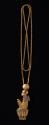
The art piece I chose is the Pendant on a Chain, created around 1070-712 B.C. during the Third Intermediate Period. The pendant depicts the ancient Egyptian myth of the sun God who emerged from a blue lotus flower, whose petals open during the day and close at night. The sun god is portrayed as both a king and a young child, with certain qualities that proclaim him as royalty. The important thing to note is that this pendant was attached to a chain, as “Egyptian art was always first and foremost functional…An amulet would have been designed to be attractive but aesthetic beauty was not a driving force in its creation, protection was” (Mark para. 2). The small size of the pendant and the chain attached provides functionality so that someone can carry it, keeping the warmth, protection, balance, and creation of the sun god around with them always. It is also important to note the time period during which this piece of art was made. During the Third Intermediate Period of Egypt, there was a fragmentation of policy and authority, resulting in limited resources. The art was affected by these difficult times, but it was still of exceptional quality. “Egyptologist David P. Silverman notes how ‘the art of this era reflects the opposing forces of tradition and change'” (Mark para. 24). The pendant was a symbol of rebirth and allowed for its wearer to embrace the vitality and divinity of the sun god during those difficult times.
In your response you mention that “Egyptian art was always first and foremost functional…An amulet would have been designed to be attractive but aesthetic beauty was not a driving force in its creation, protection was” (Mark). I think this is really interesting because its similar to how some people may chose to wear a Cross or Star of David on a necklace. Some people may do this a way to wish for luck or protection. Others do it as a way to identify themselves with their faith. I also think it’s worth asking if the wearing around the neck is symbolic in religion. It also reminds me of the Venus of Willendorf as it is a small portable token meant to serve as a connection to religion that can be carried with one wherever they go. However both the Venus and the Egyptian Pendant depict actual deities whilst modern religious necklaces depict not god, but a symbol representative of god
I agree that the small size of the pendant was probably to make it so it could be easily carried, granting whoever possessed it good luck. Joshua Mark’s article also mentions, “The style of these later periods was affected by the times and the limited resources, but the art is still of considerable quality” (paragraph 24). The lack of available resources to may have contributed to the choice to craft a pendant instead of a larger totem or statue. I also feel that, similarly to what you said about the pendant symbolizing rebirth, it may have served as a symbol of fertility. The pendant depicts the first living being as a child, being born from a lotus flower, almost sitting in the fetal position.
Attachment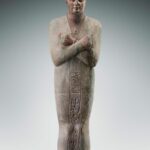
This is the Osiride Statue of King Mentuhotep III, made in 2010–1998 B.C., which is the middle kingdom period of Egyptian art.This piece was a life-sized statue of Mentuhotep III. I found this piece interesting as it shows the increase in the realism of the art coming into the Middle Kingdom era as seen in the “A Brief History of Egyptian Art” article where it says “This emphasis on life on earth is reflected in less idealistic and more realistic artwork.” While at the same time maintaining that sacred and religious aspect of the piece through, having Mentuhotep’s arms cross across his own chest as well as wearing a tightly fitting garment identifies the king with Osiris.
I agree this piece is very intriguing, although I approached it from a different perspective. I found it very odd that even though “The most striking aspect of Middle Kingdom art, however, is the subject matter. Common people, instead of nobility”(Mark), as stated in Joshua Mark’s article “A Brief History of Egyptian Art”. The fact that they created a noble figure, and then, in my opinion, idealized it by having it stand outside the temple of the warrior god Montu at Armant(MFA Boston). This, along with the position of Mentuhotep III’s arms, as Hero stated, definitely makes this feel like a sacred piece. Which I thought was interesting because it went against the normal art of this period and was idealized by the people.
I agree with your statement on the Osiride statue of King Mentuhotep and I also found it interesting how the piece blends the realism we see often in middle kingdom art with their religous beliefs. In “A Brief History of Egyptian Art” the article writes “This emphasis on life on earth is reflected in less idealistic and more realistic artwork”. The crossed arms and tight garment show that this king is someone who would continue to exist in their afterlife. But in the piece he looks much more like a real human being at the time than the very idealized portraits of rulers we see often from that era.
Attachment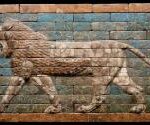
The art piece I selected is the Striding Lion created in 604-561 B.C. It could be found as one of many lions on the way to the temple of Marduk. The lions lined the sides of the way, representing luxury and power. The sculpture follows a traditional style of a bas-relief as commonly used in Mesopotamian art. However, this works use of glazed brick as opposed to the standard chiseled makes it exceptionally grand. The Striding Lion also leans into a common theme during this time. Lions were often depicted because of “the king’s personal courage during hunting expositions.” (Strickland, 7) Typically the lions would be seen with arrows impaling their skin, as they fall to the kings might. The bas-releif here does not depict such images, differing from the common representation.
According to the British Museum, “The most dangerous animal in Assyria was the lion, which came to symbolise all that was wild and chaotic in the world,” (Brereton). It’s interesting that, as Isabelle said, the lion is not depicted as being slain by a king, as is typical in Assyrian art, and is instead striding proudly and fiercely on the way to the temple of Marduk. I wonder if that symbolizes Marduk’s dominion over even chaotic, wild animals like the lion, since he himself is the embodiment of order over chaos.
Attachment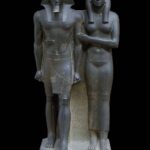
The artowrk of King Menkaura and queen is made of greywacke and was created during the 4th dynasty. It shows 2 figures facing forward and their bodies appear to be touching in the art piece as the queen wraps her hand around his waist. The king and queen are both meant to be depicted as the ideal figure for the gender with the king’s strong frame and low cheeckbones. While the queen has narrow shoulder and a slim body which was ideal feminity at the time. The idea of expressionless figures was famous for the era and that is shown in the piece (Paragraph 14) through the expressions but not through the body language from the queen. Her arm around him is a clear sign of a expression during a time where that was incredibly rare. I found it interesting and unique for the time period.
I agree that this show the idealise bodies of the society at the time. Furthermore, i think this is also introducing the symmetry which conveys divine order. The King and Queen are depicted calm with timeless expression showing the stability. Moreover, the Queen is depicted gently touching the king emphasising the support continuity, yet illustrated in a smaller scale, this highlights the hierarchy at the time. Discussed in the reading shown how the sculpture does not intend to capture the moment but express the eternal vessel of ka display the king’s authority (Robins, The Art of Ancient Egypt6).
Attachment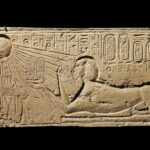
The piece I chose is an Egyptian relief of Akhenaten as a sphinx. Akhenaten was Amenhotep III’s son and when Akhenaten inherited the throne, rather than following in his father’s footsteps, he began a series of religious and artistic reforms. “During this time (known as the Amarna Period) art returned to the realism of the Middle Kingdom” (Mark par. 21). This relief is a representation of this reform through its depiction. The piece depicts Akhenaten as a sphinx making offerings to his god, Aten, and nowhere in the relief are there any unnecessary details: the sun is drawn simply as a circle, there are no facial expressions or emotions depicted on Akhenaten’s face, everything is relatively straightforward in its depiction. Mark writes about idealism, “During the reign of Queen Hatshepsut (1479-1458 BCE), although the queen is depicted realistically, most portraits of nobility show the idealism of Old Kingdom sensibilities with heart-shaped faces and smiles” (Mark par. 21), and the directness in the relief’s depiction shows an abandonment of the Old Kingdom’s traditional, idealistic art.
Attachment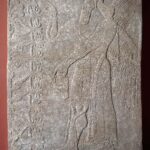
This piece, Relief of a protective deity is attributed to the Neo-Assyrian period during the reign of Ashurnasipal II between 883-859 BC. This relief, akin to those long sculpted through the lands of the Assyrian Empire (stretching from the Mediterranean to Iran) differs from the many others I have seen in that it does not portray conflict (Bereton, 2018). Reliefs of this kind tend to display Kings and/or their battles, displaying the power and strength that Shepherd Kings must pocess. Even those reliefs that portray less violent scenes, like that of Ashurbanipal relaxing in his garden (The British Museum, 2018), still eminate some conflict through the defiled head of an Elamite King hanging in the garden, reminding all of the Kings ruthless nature to those who threaten his realm. The Relief of a protective deity displays an gigantic, godly, antediluvian sage fertilizing a “sacred tree” (MFA Boston). Notably, the act of fertilization does not, in any way, include violent conflict. This is important because it reminds the audience that while a King, like a shepherd, must be strong, he is also expected to bestow upon his people a just and prosperous rule. The fertilization of the tree represents an act of forward thinking as the process will be sure to provide a bountiful harvest and see the people fed and prosper. Meaning the King is so wise as to think ahead to see to it that his flock have their needs met. While some might say that because the relief doesn’t depict Ashurnasipal II and therefore it should not be attributed to his character, we must remember that a King does not act alone. We know a king would have a council of governors, high officials, and even spy masters at his side (Bereton, 2018). In addition, we know that Kings in Assyrian mythos, like Babylonian, were considered godly and therefore had a relationship to religious culture. With this in mind, it can be theorized that the sage, performing a ritual upon a “sacred tree”, may serve as an extension of the Kings power. Thus, reminding the people that they are successful because of his efforts and because he presides over their care.
Attachment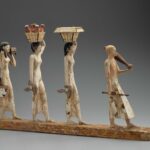
The art piece I chose was The Bersha Procession, created in late Dynasty 11 – early Dynasty 2010–1961 B.C. This piece was beautifully and very carefully carved to display a man and three women bringing oblations to maintain the ka of Djehutynakht in the afterlife. This procession of offering bearers was usual for the Middle Kingdom, considering that “Their [Egyptian society] overriding concern was assuring a comfortable afterlife for their rulers, who were considered gods. Colossal architecture and Egyptian art existed to surround the pharaoh’s spirit with eternal glory” (Strickland 8). The art of immortality was crucial to Egyptian society, which is why pieces like this weren’t unusual; however, due to its expertise and precision, it was exceptional.