Due Apr 15
Enlightenment Satire
Viewing: two moral satires by William Hogarth:
- A Harlot’s Progress (1731-1732)
- A Rake’s Progress (1732-1734)
Reading: Voltaire, Candide, Chs 1-14 (pp 1-47)
Writing: Respond to ONE of the following prompts. Keep your response short, posting as a reply under the appropriate heading in the comments section:
- Finding the funny: Hogarth’s engravings can feel a bit preachy, but they’re filled with humorous details. Draw our attention to a key detail and comment. (Feel free to attach a closeup image of the detail you’re interested in.)
- Finding patterns: a lot happens in Voltaire’s satirical novel; help make sense of the chaos of events by noting a pattern, something that happens repeatedly.
- Progress: what sort of “progress” happens over the course of Hogarth’s image series—or Voltaire’s novel? Cite a particular detail from one of these three “texts” as example or illustration.
Finding the funny
⤹Click the reply button just below.
A detail i found somewhat humorous was the detail of the pans falling over in the “Arrival in London” engraving. The falling pans serve as a rhetorical “alarm” for the shift in Moll’s journey; going from a country girl, to a “fallen” woman, like the pans indicate. Hogarth is demonstrating how people can be oblivious to their own demise, as she is unaware of the loud crash which is soon to occur.
I agree that this detail signals a change in her identity as a woman. Her obliviousness to falling pans may also symbolize society’s unstable foundations, which most people ignore. Despite London’s outward progress, it was marked by severe wealth disparity, which ultimately pushed the harlot into prostitution. I think that the pans may indicate a bigger societal issue than just the woman.
I completely agree with you, Campbell. The falling pans are a great touch added by Hogarth, acting as a noisy little “alarm” for Moll’s upcoming downfall. It is pretty funny but also dark. This highlights her distraction of her new life that she doesn’t even notice the literal and metaphorical crash happening right behind her.
I agree with this, you guys! I think a detail that can be added to this idea is the people in the back gossiping and gasping. With community and social hierarchy at play, whatever is going to happen to her is definitely moving around the town. Even the horse and goose are sniffing around for the drama!
Attachment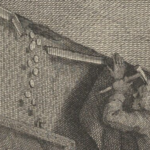
From The Inheritance in A Rake’s Progress, I found it funny that coins were falling from the ceiling. There is a person hitting the line between the ceiling and the wall, and there is a hole from which items are falling. It initially looked like dust or bugs, but dust is far too diminutive to look like that. Besides, I didn’t see any limbs on it, so it couldn’t be bugs. The only other option that came to my mind was coins. There were coins raining down from the ceiling.
I also found this detail very interesting because this scene depicts the inheritance of money this man gets, and the notion that money is just “falling from the sky” is quite literally shown through this portrait. I find it interesting that nobody but the man working on the ceiling is noticing this even happening, and I think this might tie to the idea that people don’t think about where the wealth is coming from, more of the person you holds it. Also, everyone’s attention is solely on the man this portrait depicts, and these little details of coins allow us to see, from the artist’s perspective, the “hidden” or unacknowledged aspects of his life.
I absolutely agree with your angle that the money falling from the ceiling propagates the idea that people care less about where money originates or stems from, but care more about who’s in possession of said money. In this image, the coins are falling from the most unlikely of sources, and because of this, only one individual takes notice, seemingly patching or attempting to gather the coins for himself in order to keep the secret alive. The irony of the coins falling from the borders of a ceiling and that urgency and inconspicuous nature at which the man attempts to deal with the currency is what adds a great deal of humor to a relatively straightforward, intentional image.
My interpuration was that the person who they were inheriting the money from was a frugal and was hiding it as they didnt trust that they wouldnt be robbed. It also would seem like the money is less dangerous if its hidden in the roof because its not being spent on vices and other bad things like it is in the other images in the series. I dont know that I find this detail funny but I can see how it might have been intended to be comical.
one detail that I find very interesting is in A Harlot’s Progress by William Hogarth. This scene seems to be less chaotic compared to the others, yet when we look closely, the scene portrays the tragic events of Molly, which is presented in a courtroom, supposed to be a place full of seriousness and formality. On the left side, we see 2 dogs randomly mating in peace. This almost seems to be a bit sarcastic, as it makes the image more ridiculous. This contrast of the life of Molly, which is falling apart in tragedy, yet the presence of the 2 dogs is separated from all the others as they are just doing their own thing. Further, the fact that one dog is higher than the other depicts exactly the same position as the humans when the judge is at a higher position, almost mirrors the human hierarchy in the scene. It is perhaps a small visual joke, however also reinforces the power difference in the room. The artist seems to be mocking the seriousness of the court by paralleling it with something crude, the dogs, happening right next to it.
I also found this detail interesting because in A Harlot’s Progress the courtroom is supposed to feel serious and formal, but Hogarth slips in this small moment on the left where two dogs are mating completely unconcerned with everything going on. It’s kind of ironic because this very human setting full of judgment and authority is being “mocked” by something so natural and uncontrolled happening right beside it. What stood out to me is that nobody in the scene seems to have a reaction to it, which makes it feel like it’s both hidden and obvious at the same time, like something people just overlook even though it’s right there. I also think the way the dogs are positioned slightly echoes the hierarchy of the people in the courtroom, almost like a visual reminder that power structures exist everywhere, not just in human institutions but around the natural world.
In “A Kept Woman” in Harlot’s Progress, the main character is having a conversation with her rich “protector.” To help her secret lover sneak out of the room, she kicks the table over. The table is falling, the tea set is crashing, and the rich man is surprised by the mess. This detail is very funny because the rich man thinks he is the “master” and very powerful, but Hogarth shows he is actually a fool. The humor comes from the chaos; the woman uses a simple “accident” to hide her real life from the man paying her bills.
I also found the chaos created in this piece to be very humorous. I specifically find the man’s expression to be very funny because he appears to be in utter shock while the woman is just smiling. I also find it funny how the other characters, such as the monkey and the man and woman in the background, are also leaning away from the lady. She surprised everyone, even the animals, with her disruptive behavior.
One interesting and quite funny detail I happened to stumble across on the art piece titled “New Vices” under the Rake’s Progress gallery. The unique action which I witnessed was one woman spitting into another’s mouth. This reflects the interesting desires of the time and the chaotic, lust-filled environment in the painting.
I also found this detail interesting in the painting, as it is quite brazen. However, when I look at the two women, I see it more as contributing to the chaotic nature of the painting, rather than its lust-filled aspects. The two women look to be in some type of dispute. The woman who is spitting has a liquor bottle in her hand, while the woman being spit at looks somewhat angry and is holding a knife. Everything happening in the image is a complete mess, and everyone seems drunk out of their minds, which these two women seem to be adding to.
I did not notice this but I agree this is quite interesting. I agree with you that it’s to push forward the theme of lustful environment there, a place with no manners at a table. You can see someone hand slipping into another’s shirt, while another person undressing in the back. The chaos is a clear theme that they are trying to associate with lustful thoughts.
Attachment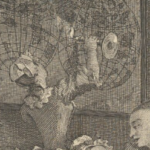
I will certainly agree with you on the chaos. Except, what drew my eye was a young woman so out of her mind as to try to light an expensive looking map of the world with a candle stick. She’s probably drunk out of her mind, having given to some vice during the “party”.
I do like the detail you pointed out as I think it does speak to the bigger context of the piece. The series of engravings tell the story of a young man after inheriting a fortune from his relative. I think details like the one you pointed out along with others like a woman sticking her hand down a man’s shirt contribute to the overall chaos of the piece but also address the background of the engravings, highlighting the boldness and unfettered empowerment somebody feels with a newfound fortune that they didn’t really have to work for.
A funny and interesting detail I found is in “New Interests” under a Rake’s Progress. Tom is dressed in expensive clothing at his new home accompanied by other prominent men. There is a musician, possibly George Fredric Handel, is on the left side at the piano with a book in front of him. From research, the book is inscribed with the names of performers and their works. The pages go all the way down his back onto the floor. By using a famous composer to represent the musician and comically lengthening the pages of the book, I think Hogarth is mocking Tom’s need for extravagance in terms of music taste. I think the entire scene is mocking Tom’s poshness with the expensive clothes, the nice house, and the guests. Tom is put at the center of attention, and even his facial expression shows a bit of cockiness and pride.
A more subtle detailed I noticed was Moll’s luggage and how organized it was compared to the rest of the scene, especially her luggage with her initials on it. It kind of shows how naive and innocent Moll, like she just arrived to london with everything she owns, thinking it’s a fresh start, yet there are shady figures and chaos already surrounding her everywhere. The humour to me comes from this contrast, she thinks shes entering a land of opportunity, but the audience can already see she’s completely out of her depth.
First of all I really loved both of these works. I have never seen stand alone pieces from this time period used to tell this sort of story. In The Rakes Progress in the third image, “New Vices”, one thing I found funny was the lady holding the candle so close it could burn the map. She was not holding it upright but rather sideways to touch the material. Out of all the humorous details this one was by far my favorite. This image is also fully of funny details you would miss at a quick glance. The woman trying to drink her soup and missing completely, and the other spitting at another are also quite humorous details.
A detail I found particularly interetesing in Hogarths engravings comes from “A Common Prostitute” where we see witch clothes hanging from the ceiling to the left. The painting has no discrenable connection to any mythic tellings or fantastical stories from what I’m able to discern but Hogarth uses the witch clothing regardless to juxtapose the form setting of the piece.
Finding patterns
⤹Click the reply button just below.
I feel like Voltaire follows a three step pattern throughout the novel thus far: Candide finds his footing, something terrible happens to him that uproots that, and he relies on the generosity of someone else to find his footing again.
For instance, Candide has a comfy life inside of Baron Thunder-ten-tronkh’s castle, but gets thrown out. This means he has to go to the Prussians, who generously give him food and shelter, but also enlist him in the army! He escapes, and again has nothing. He’s forced to rely on the generosity of James, the Anabaptist to regain some normalcy in his life, but then James gets killed in a shipwreck and the cycle repeats!! It really is one thing after another with Candide.
I completely agree with you. One thing I noticed, too, is that all the tragedy is usually incredibly graphic and violent death. With Cunegonde, her family, his master, and the nice man who helps him. Cunegondes death in particular is described as extremely brutal. Also, another interesting thing I noticed is how often someone seems to have died, and then Candide finds out that they actually didn’t later on.
I agree with this point, and I feel its as though Candide is being tested to see if he can ever stand on his own, and the answer so far is no. He keeps building dependency by just moving between temporary supports that fail him instead of building his own stability.
Finding Progress
⤹Click the reply button just below.
Over the course of each of the image series, the main subject is depicted as having something “positive” happen to them in the beginning. In “A Harlot’s Progress,” for example, the main subject arrives in London and is dressed very nicely, implying she is of higher status compared to the woman greeting her. As her time in London continues, however, she is placed in increasingly precarious situations, with the number of mouches, or the black beauty marks, on her face increasing, hinting at her contraction of syphilis. This paired with her clothing, which becomes more common with each painting, symbolizes her lifestyle change, implying a downward spiral up until her untimely death. Both of the image series end with the subject losing all they had at the beginning. If I had to guess, I would say these paintings suggest the common folk were seen as being unequipped to handle noble status and wealth appropriately and, when they were granted wealth and power, they mishandled it and lost everything. These paintings seem to be poking fun at the lower classes.
I totally agree, especially with your point that the “progress” is moreso a downward spiral than actual improvement. To add onto your ideas, I think that Candide turns these ideas of progress into being less so about social status and more about philosophy. At the beginning, Candide believes that everything happens for a reason, but after witnessing violence he questions that idea. So, while he may not be necessarily socially progressing, he is advancing his thoughts.
Over the course of both “A Rake’s Progress” and “A Harlot’s Progress” we see beautiful and vital young people fall into what was considered “sin” and face punishment from both society, in the form of the courts, and also presumably from God, in the form of madness and illness. I find it striking that the faces of both youths at the beginning of their “Progresses” appear almost angelic in their young and unspoiled facial features. In both scenes, this unspoiled beauty is starkly contrasted by the aged faces that surround them, many of whom have expressions of speculative greed, as if measuring how much value they can wring from the youths. This seems to imply that both of these young people were enticed and led astray by people who were already corrupted. I find this interesting because it establishes a theme consistent across each “Progress” which is that its subjects are treated with both pity and mockery.
Your point about the tension between pity and mockery helps clarify what kind of “progress” is actually unfolding in these works, since it is less about improvement and more about a moral and social descent that feels almost inevitable. In A Rake’s Progress, the devolution is not a result of personal weakness but part of a larger system that encourages and profits from excess, something already visible in the second scene where the Rake is surrounded by figures like tailors and musicians whose exaggerated attentiveness suggests they are actively feeding into him. A similar pattern appears in A Harlot’s Progress, particularly in the opening scene where her arrival in London immediately turns into an ambush, making her “progress” feel less like a gradual fall and more like instant fall into a society that commodifies her youth and beauty. This reinforces your observation about the predatory expressions of those surrounding the protagonists, as they represent not just individual corruption but a broader system that emphasizes turning innocence into profit. Seen alongside Candide, this idea of “progress” becomes even more ironic, as Candide’s journey exposes him to repeated instances of suffering, suggesting that progress is slap in the face of the realities of the world.
These images from Hogarth’s A Harlot’s Progress (1732), depict a “progress” that is deeply ironic, it traces not advancement but decline. The series follows a woman’s descent through London society. She arrives naively from the countryside (“Arrival in London”), briefly enjoys material comfort as a kept woman, then falls into street prostitution, imprisonment, disease, and finally death. The progression moves with grim inevitability downward through every social and physical register. A particularly striking depiction of this is the contrast between image 2 (“A Kept Woman”), where she sits in a furnished room with fine clothes and a servant, and image 5 (“Dying of Syphilis”), where she is shown wasting away, surrounded by chaos and indifferent onlookers. What makes Hogarth’s irony so sharp is that the word “progress” in the 18th century carried connotations of a formal upward journey, so the title is a bitter joke. The woman’s “progress” through London society is really a downfall, each stage stripping away whatever she gained in the last.
I agree that the images from Hogarth’s A Harlot’s Progress demonstrate a downfall rather than progress through London Society because not only is every stage slowly destroying the person she once was, but also shows how common people react and interact with her at various stages of her life. For instance, the first image (“Arrival in London”) shows how a common lady seems welcoming and kind to the young lady, and then in the fourth image (“In Bridewell Prison”) depicts how the young lady seems to be looked down upon and is being controlled. So, not only is the young lady’s progress declining, but it also captures the emotions and attitudes of how society viewed her from the beginning of her arrival till the end.